Tea lights & candles
Handmade tea light holders and candle sets
Small pieces, and the ones people buy in pairs and half-dozens — for Diwali, for a table setting, or as the gift you give when you do not want to give another box of sweets. Each one is made and decorated by hand, so a set has the small variations that tell you a person made it.
Made to order in Sector 67, Gurugram · from ₹700 · shipped across India & worldwide
Ordering these for Diwali 2026
Diwali falls on Sunday 8 November and Dhanteras on Friday 6 November.
Tea light holders are among the quicker things I make, but they are still made one at a time, and ordering for Diwali has now closed. A new set started today would not be dry and delivered in time.
If you are reading this before Diwali and want to ask anyway, do. A pair or a set of four is the usual order, and if something part-made happens to suit you I will say so. After the festival, these are just as good for a wedding, a housewarming or a table that needs lighting.
Two styles
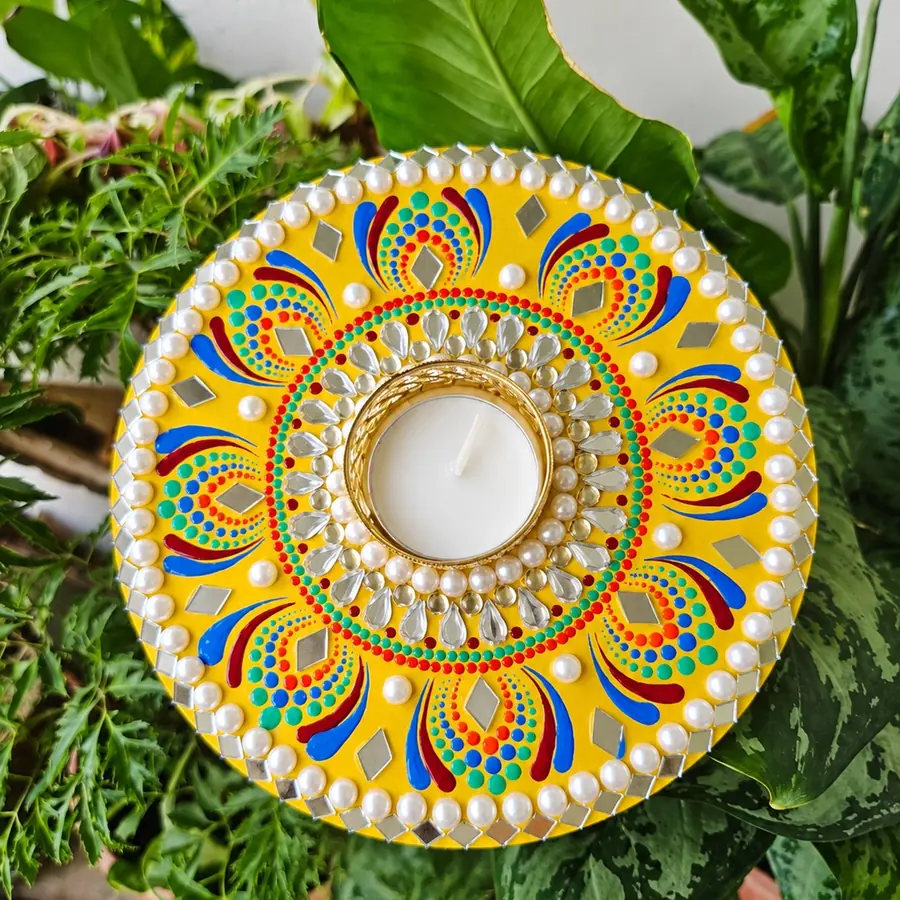
The dot-art plates are painted freehand in colour — concentric rings of dots built up around a central well for the tea light, edged with pearls and small mirrors. They are the brighter of the two and photograph well against a dark table.
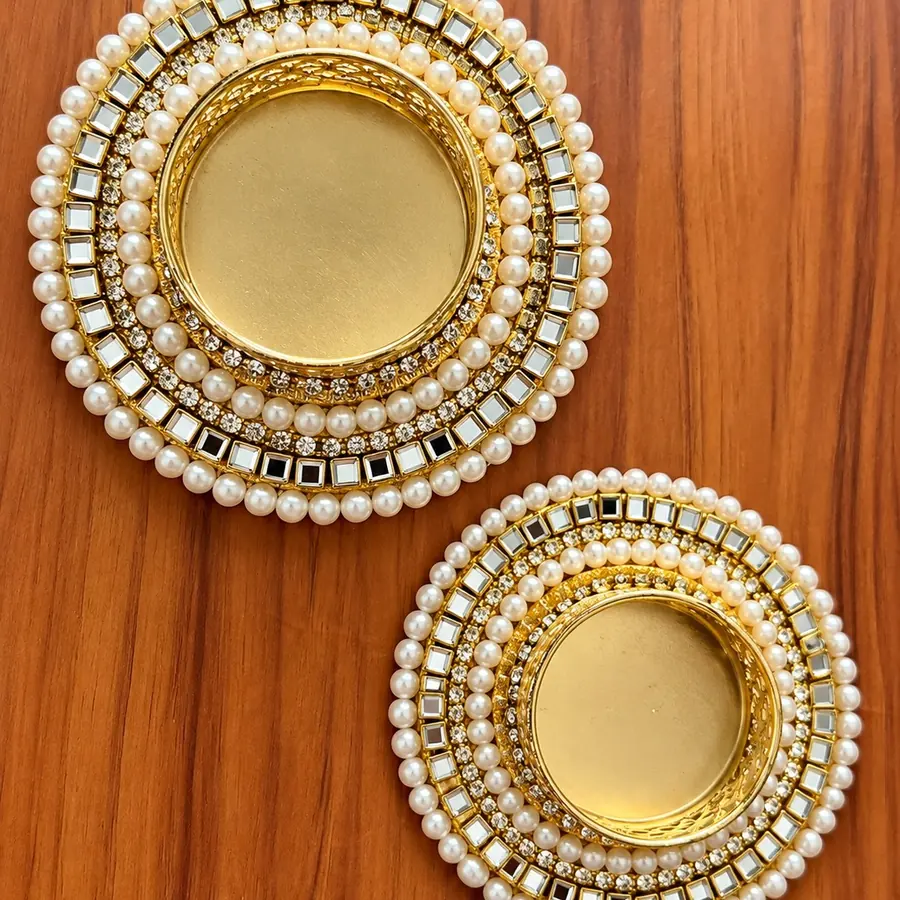
The pearl-and-kundan holders are quieter and more formal: a gold well surrounded by kundan stones and rows of pearls. These are the ones usually ordered in pairs for a mantelpiece or a dining table.
Why they work as gifts
They are useful, they are small enough to post, and they are unmistakably handmade — which is most of what people want from a Diwali or housewarming gift.
For festive gifting I take bulk orders. Tell me the quantity and the date you need them by, and I'll tell you honestly whether it is possible in the time, because these are still made one at a time.
Using and caring for them
They are made for tea lights, not for pillar candles or open flame sitting directly on the surface. Keep the tea light in its metal cup.
Wipe with a dry cloth. As with the wall pieces, keep water away from the decorated surface.
What goes inside them
A standard tea light is about 38mm across and sits in a thin aluminium cup. That size is near enough universal, so anything you buy off a shelf anywhere will drop into the well. The wells are made to that measurement rather than to a particular brand.
Burn time on a standard wax tea light is usually three to four hours. For Diwali night that is the thing worth planning around, because lamps lit at dusk will not still be going at midnight. People who want them burning all evening buy twice the number and swap them over, which is easier than it sounds since the cups lift straight out once cool.
Ghee or oil is the traditional fill and it works, though not directly in the well. Use a small steel or clay insert, put the ghee and wick in that, and sit the insert where the tea light would go. Ghee poured straight into a decorated plate will soak into anything porous and you will not get it out.
LED tea lights fit the same wells and are the sensible choice in two situations: a house with small children or a cat, and a balcony or window where wind keeps putting a real flame out. They look convincing in a decorated holder because the holder is doing most of the visual work anyway. The light is flatter and colder, so if the plate has mirror or kundan on it you lose some of the flicker that makes those materials move.
What does not work is a pillar candle balanced on top. The well is shallow, the candle is top-heavy, and wax running down the side onto painted detail is permanent.
Heat, soot and a painted surface
The flame never touches the plate, and that is the whole design. The well holds the metal cup, the cup holds the wax, and the flame sits above the rim with air around it. Heat reaches the plate by conduction through the base of the cup, which is slow and low.
That is why the metal cup matters more than it looks like it should. Take a tea light out of its cup and set the bare wax in the well and you have moved the flame down, put melting wax in direct contact with the surface, and concentrated the heat in one spot. On a painted plate that is how you get a scorch ring.
Soot is the other thing. Any wick smokes a little, and more if the wick is long or the flame is guttering in a draught. Over a few evenings a faint grey film builds on the rim directly above the flame. It wipes off with a dry cloth while it is fresh. Left for a season it combines with dust and stops wiping off cleanly, which is the usual reason a holder looks tired after a year.
Trimming the wick helps more than anything else. A wick standing more than a few millimetres proud of the wax burns tall and dirty. Pinch it shorter before lighting and the flame stays small, steady and almost smokeless.
None of this makes these fragile. They are meant to be used, and used often. It is just that the difference between a holder that looks good in its fifth year and one that does not comes down to a cloth and thirty seconds, not to anything structural.
How many you actually need
Two looks deliberate. One looks forgotten.
That is most of the advice, honestly. Single objects read as accidental on a table or a sill unless they are large enough to be the only thing there, and tea light holders are not large. Pairs are the smallest number that looks intentional, which is why pairs are what most people order.
For a doorstep or the two sides of a threshold, two or four. Four lets you run two either side, which handles a wider door and looks less sparse once the rest of the entrance is decorated.
Along the edge of a rangoli, the number depends on the rangoli rather than on the holders. A small one at a flat door takes four to six around the outer ring. Anything larger and you are better off spacing six or eight evenly than crowding twelve, because an unbroken ring of light flattens the pattern you drew underneath it.
On a dining table, three down the centre of a six-seater is the arrangement that comes up most, with the caveat that odd numbers work better than even ones in a line. For a longer table, five.
Balcony railings swallow more than you expect and are also the worst place for a real flame, so this is where the LED point above matters. Eight along a standard flat balcony is not unusual, and at that quantity it is worth asking about a set price rather than ordering them one at a time.
Storing them between festivals
Wrap each one separately. Newspaper is fine, bubble wrap is better, and the thing you are protecting against is not impact so much as two decorated surfaces rubbing against each other in a box for eleven months. Pearls and kundan sit proud of the surface and will scratch the plate stacked under them.
Do not stack them directly, even wrapped, more than three or four deep. The weight is small but it is constant, and it concentrates on whatever bit of the decoration happens to be highest.
Where you store them matters more than how. A box on top of a wardrobe is dry and stable and fine. A box in a loft, a garage, or against an external wall goes through the full monsoon at high humidity, and clay and painted finishes both take up moisture. If the only space you have is somewhere damp, put a couple of silica sachets in the box, the kind that come packed with shoes.
Check them before the next Diwali rather than on the evening itself. Give each one a wipe, look for a loose pearl, and if something has come away it is a small repair with time in hand instead of a problem at six in the evening with guests arriving.
Variation inside a set
A set of six will not be six identical objects, and it is worth knowing that before you order rather than after.
The dot-art plates are painted freehand. Each ring of dots is placed by eye, so across six plates the spacing shifts slightly, a ring might carry forty dots on one and forty-three on another, and the colour weight varies a little depending on how much paint was on the brush. Held side by side you can see it. Lit on a table two feet apart, nobody has ever noticed.
The pearl-and-kundan holders are more consistent because the components are uniform, but the setting is still done by hand and the rows are not machine-spaced.
If you need genuine uniformity, for a corporate order where the pieces will be photographed together or lined up on a table, say so when you order. I can keep a set tighter by making them in one sitting from the same batch of paint, which is not the same as identical but is as close as handmade gets.
Questions before ordering
What size tea lights do these take?
Can I use ghee or an oil wick instead of a candle?
How many should I order for a doorstep or a rangoli?
Will the pieces in a set look identical?
What does a piece cost?
Do you ship internationally?
Can I order these in a set?
Do you take bulk orders for Diwali or corporate gifting?
Are these safe to use with a candle?
Can I choose colours to match my table?
More photos of this work