Small spaces
Choosing art when the wall is small
Large walls go wrong because people buy something too small for them. Small walls go wrong the other way round, and the error is harder to recover from, because an oversized piece in a 1BHK does not just look awkward, it makes the room feel smaller than it is. In a compact flat the useful question is what will leave the wall room to breathe.
Made to order in Sector 67, Gurugram · from ₹700 · shipped across India & worldwide
Measure what is actually free
The wall is not the wall. The usable area is what is left after the switchboard, the AC, the door swing, the curtain rod bracket and the fan clearance have taken their share.
Measure the clear rectangle rather than the full wall. In most compact flats the honest number is a lot smaller than the one people start with.
Then take away another 15cm on each side. That margin is what stops a piece looking wedged in.
A worked example, because the numbers help
A bedroom wall 180cm wide with a bed against it. The bed is 150cm. Two-thirds of 150 is 100cm, so a single piece around a metre wide would be right in a larger room.
But the wall is only 180, so a 100cm piece leaves 40cm each side. That is tight but workable.
Drop to 75cm and you get 52cm each side, and the wall starts to breathe. In a small room I would take the 75.
Above the bed, go wide and low rather than tall. You want the eye to travel sideways, not up into a low ceiling.
One piece or a tight group
In a big room a group gives you flexibility. In a small room a group usually adds visual noise, because the gaps between pieces are themselves information the eye has to process.
One piece, well sized, is almost always the better call under about 200cm of wall.
The exception is a vertical run, where three small pieces stacked can work on a narrow strip that no single piece fits.
The spaces people forget
Above a door frame. Most flats have 30 to 50cm of dead wall there and nobody uses it.
The narrow strip beside a window, where a tall thin piece fits and nothing else will.
The return wall of a passage, seen end-on as you walk towards it.
The wall above a fridge or a washing machine, which is usually ignored and is often the only clear surface in a small kitchen.
None of these take a large piece. All of them take a small one well.
Why relief work suits a small room
In a compact flat you are always close to the wall. You see the piece from a metre away, not from across a room.
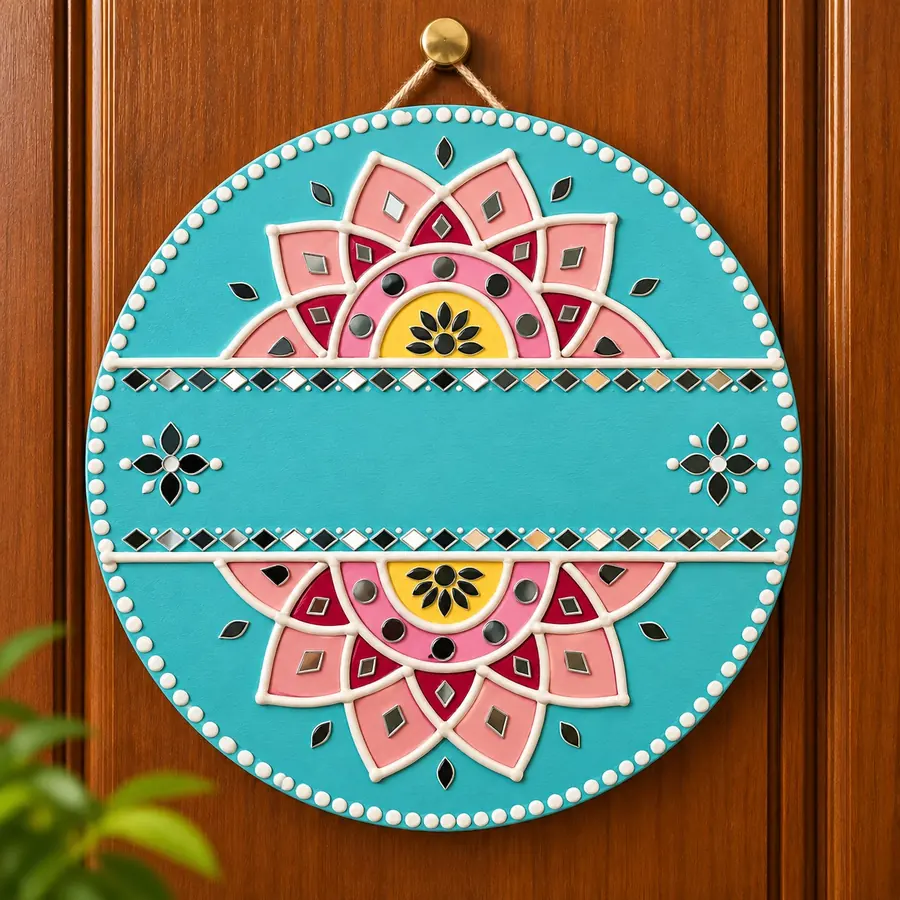
At that distance texture is doing the work and detail is legible. Clay relief and set mirrors reward close looking in a way a large printed canvas does not.
It also means you can go smaller without the piece feeling thin. A 30cm Lippan panel at arm's length has more to look at than a 90cm print at the same distance.
Colour, and the myth about pale
The standing advice is that small rooms need light colours. It is half right.
Pale walls do help a room read as larger. But a pale piece on a pale wall disappears, and then you have spent money on something nobody notices.
Contrast between the piece and the wall matters more than the overall lightness of either. A dark green panel on a cream wall gives the room a focal point, and a focal point makes a small room feel deliberate rather than cramped.
Traditional Lippan is white clay on a dark ground, and that combination is one of the better things you can put on a pale wall in a small flat.
Furniture you cannot move
In a 1BHK the sofa goes where the sofa goes. There is usually one arrangement that works and no second option.
So measure around the furniture rather than planning to move it. Size to what is above the sofa, not to the wall the sofa happens to be on.
If the only free wall is behind a door that stays open, accept that and pick something the room will see when the door is shut.
Studio flats, where the wall is doing three jobs
In a studio the same wall is often behind the bed, beside the kitchen counter and in the background of every video call.
Pick the function that matters most and ignore the others, because a piece that tries to suit all three suits none.
Keep clay away from the kitchen end regardless. Steam carries further in a single room than people expect, and a studio has nowhere for it to go.
Ceilings, and why low ones change the maths
Most newer flats in Gurugram have ceilings around 2.7 metres, and some of the older ones are lower.
Under a low ceiling, the gap above a piece matters more than the gap beside it. Leave at least 30cm of clear wall between the top of the frame and the ceiling line or the room feels compressed.
That constraint usually means going wider and shorter than the wall width alone would suggest, which is the opposite of what people instinctively do with a small wall.
What works under 45cm
Round mandala pieces hold their shape at small sizes better than figurative work does, because the form is the subject.
Name plates, which are made small by definition and are the one piece in the house that is always seen close up.
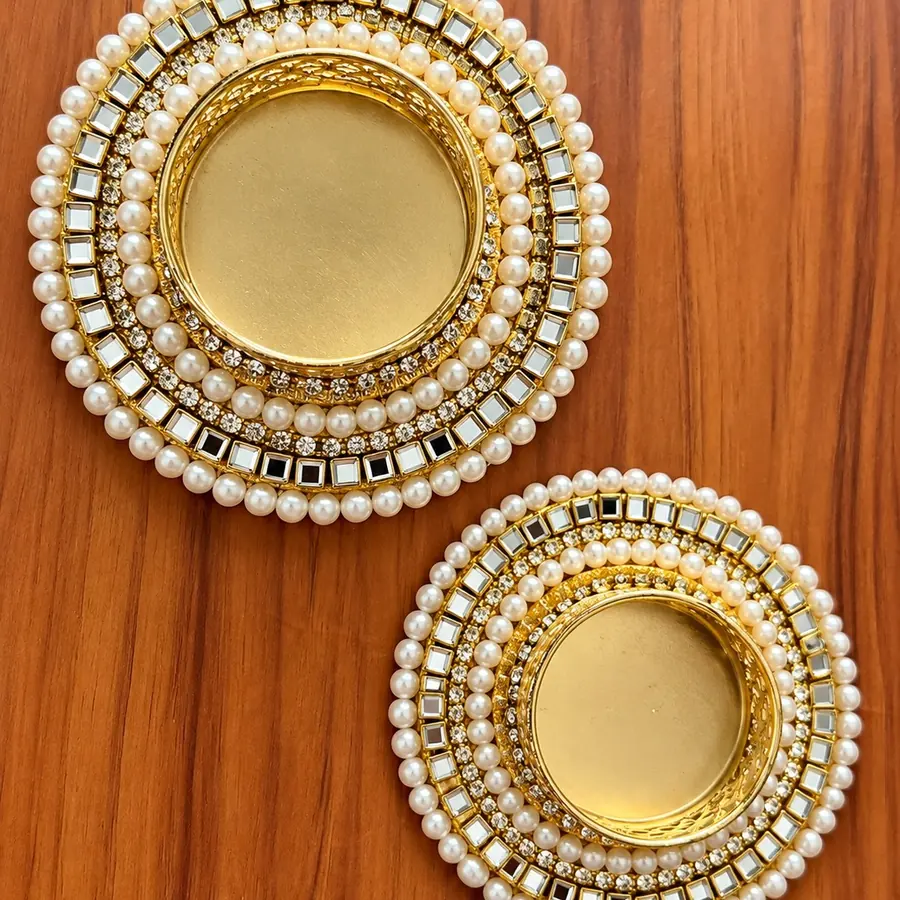
Tea light holders and candle plates, which need no wall at all and are often the right answer in a flat where every wall is spoken for.
Single Jharokha frames rather than a set of six.
Mirrors and the thing people get wrong about them
The standing advice for small rooms is to add a big mirror, and it does work, but a full mirror on a small wall also doubles the clutter it reflects.
Mirror work is a different proposition. The mirrors are small, set at angles, and they throw light around without reflecting the room back at you.
In a compact flat that is often the better trade. You get the brightness without a second copy of your laundry rack.
Shared flats and walls that are not yours
If you share, the wall above your own bed or desk is the one you can decide about without a conversation.
Communal walls are a negotiation, and the thing that usually passes is something neutral and geometric rather than something with a subject.
Pieces that sit on a surface rather than hang sidestep the question entirely and move out with you.
Commissioning to an awkward size
Ready-made art comes in standard sizes and compact flats rarely have standard gaps. This is the main reason people in small flats end up commissioning.
Send me the clear rectangle, not the wall, plus a photo with the furniture in it. The photo tells me what the measurements leave out.
Within India pieces start at ₹700. Orders going abroad start at ₹3,500, with delivery charged separately and quoted with the price.
Questions before ordering
What size wall art suits a small living room?
Is a group of small pieces better than one piece?
Can you make pieces under 30cm?
What works on a narrow wall?
Does a dark piece make a small room feel smaller?
Can you make something to fit between two windows?
What if every wall is taken?
How high should art go in a room with a low ceiling?
More from this collection