Pooja room
Decorating a pooja room wall
Most of what I am asked to make is sized to fill a wall. A pooja wall is the exception, and it is the one room where people most often get it wrong by buying something too large. The space is there to hold attention on one thing. A big decorative panel behind the idol competes with it rather than framing it.
Made to order in Sector 67, Gurugram · from ₹700 · shipped across India & worldwide
Scale first, and go smaller than you think
In a living room I would tell you to buy bigger. Here I would tell you the opposite.
A piece around 30 to 45cm is usually right for a pooja niche or a small dedicated corner. In a full pooja room with a proper mandir unit, you have more room, but the piece still sits beside or above rather than dominating.
If the piece is the first thing you look at when you walk in, it is too big.
What the tradition tends to favour
Pichwai belongs here more than anywhere else in a house. The panels were made to hang behind the idol of Shrinathji at Nathdwara, which is literally what pichh and wai mean, behind and hanging. It is the one craft I make that was designed for this exact job.
Lotus forms carry the association with purity and appear across almost every Indian devotional tradition.
Symmetry matters here in a way it does not elsewhere. A composition that is balanced across its centre settles a space. An asymmetric one unsettles it, which is sometimes what you want in a living room and almost never what you want here.
Mandala and geometric work
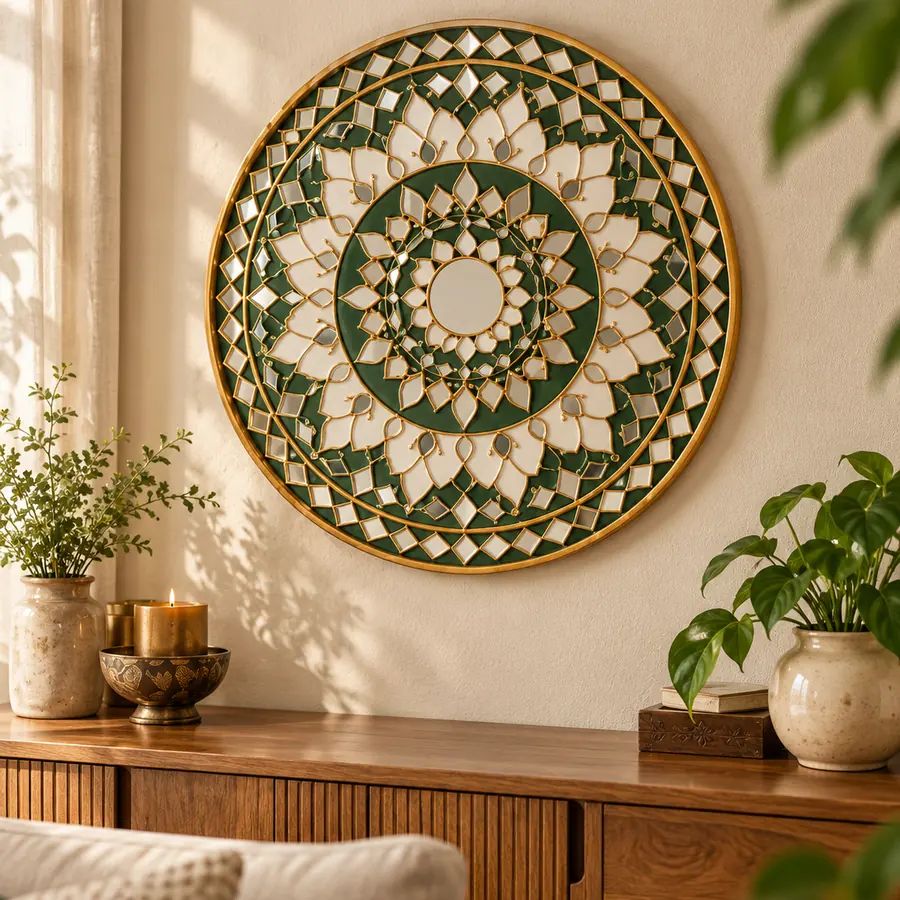
A mandala is concentric and balanced, which makes it a natural fit, and it is the second most requested thing I make for pooja spaces after name plates for the door.
Keep the ring count lower than you would for a living room piece. Dense work reads as busy at close range, and a pooja wall is always seen from close range.
A plain border rather than a figurative subject is worth considering if the idol or image is itself detailed.
Light, lamps and why mirror work behaves well here
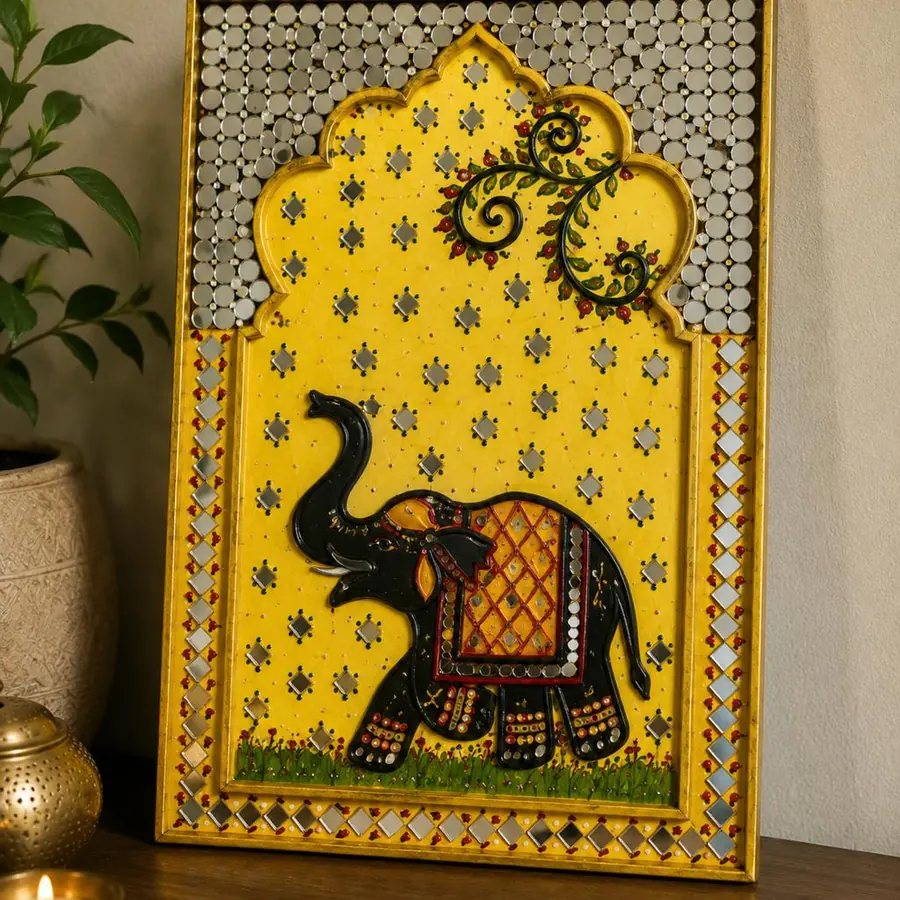
This is the one room that still routinely has a live flame in it, and mirror work was invented for exactly that situation. Abhla in a clay relief were meant to take the light of a single oil lamp and spread it.
A diya in front of a mirror-work panel does something a diya in front of a painted panel does not. The piece moves as the flame moves.
Keep the panel far enough back that heat and soot do not reach it. Directly above a lamp is the wrong place, and over a year the soot will tell you so.
If the corner has no natural light at all, mirror work still earns its place here in a way it would not on a dark living room wall, because the lamp supplies what the window does not.
Materials to keep away from the flame
Nothing with a fabric element close to a lamp. Thread work, tassels and hanging cloth belong elsewhere in the room.
Painted wood is fine at a distance but I would not put it directly over a flame.
Clay and mirror are the most forgiving of what I make, which is part of why they ended up in this role historically.
A pooja corner in a small flat
Most flats in Gurugram do not have a pooja room. They have a shelf, a corner of a kitchen counter, or a unit on a landing.
In that case one small piece on the wall behind, sized to the shelf rather than the wall, is the whole job. Anything larger makes the corner look like a display.
A vertical piece suits a narrow corner better than a round one, which is the opposite of what I would say for an open wall.
Colour
Restraint reads as reverence here and brightness does not. That is my view rather than a rule, but it holds up in most of the rooms I have seen photographs of.
Whites, creams, soft golds and the deeper greens work. Strong reds and oranges can work if the rest of the corner is plain.
Match the piece to the mandir unit rather than to the room. The unit is what it will be seen against.
Kitchen mandirs and the steam problem
A lot of flats put the pooja space in or beside the kitchen, which is practical and is the worst possible place for clay relief.
Steam is the one thing that genuinely destroys this work, and a kitchen produces it daily. The damage is slow, so people do not connect it to the location until the relief has already gone chalky.
If the mandir is in the kitchen, either choose painted wood rather than clay, or put the piece on the far wall from the hob and accept that it still is not ideal. I will tell you this before you order rather than after.
Scale against the idol
The piece is framing something, so it has to lose. If the artwork is more visually active than what it sits behind, the hierarchy is wrong.
A useful test is to squint at the corner. Whatever you still read clearly is what the eye is going to prioritise, and it should be the idol.
This is why I keep steering people towards smaller and plainer here when they came in wanting something impressive.
Keeping it cleanable
This corner collects more than any other wall in a house. Soot, ghee vapour, flower debris, and the fine ash that comes off incense.
Raised relief holds all of that in its lines. Budget for dusting it with a dry brush every few weeks rather than once a year.
No damp cloth on the clay, and no cleaning product. If something has baked on, send me a photo before you attack it.
Mandir units and what goes around them
Most people buy the unit first and think about the wall second, which is the right order. The unit sets the scale for everything else.
If the unit has carved or mirrored doors already, keep the wall piece plain. Two decorated surfaces at the same distance from the eye compete.
If the unit is simple, the wall can carry more. A single panel above, sized to the unit rather than the wall, is usually all it needs.
Flowers, lamps and the things that move
This corner changes daily in a way no other wall does. Flowers go up and come down, lamps are lit and cleaned, a thali appears on festival days.
Leave room for all of that. A piece sized to the empty wall will be crowded the moment the wall stops being empty.
I would rather make something slightly smaller that still looks right on a busy day than something perfectly scaled to an empty corner you will never see again.
Having one made to fit
Pooja niches are rarely a standard size, and this is the most common reason people end up commissioning rather than buying something ready made.
Send me the niche measurements, including the depth, and a photograph taken straight on with the lamp lit if you can. The lit photograph tells me more about what will work than the measurements do.
Within India pieces start at ₹700, and for orders going abroad the floor is ₹3,500 with delivery quoted on top.
Questions before ordering
What should go on a pooja room wall?
Is mirror work suitable for a pooja room?
What size piece for a small pooja corner?
Is Pichwai appropriate for a pooja space?
Can a piece go near a diya or oil lamp?
How do I clean a piece in a pooja corner?
Can you make a piece to fit a niche?
Which wall should the pooja space be on?
More from this collection