Jharokha
Hand-painted jharokha wall decor
A jharokha is the overhanging enclosed balcony window you see on old havelis in Rajasthan and Gujarat — carved stone, arched top, a jaali screen to look out through without being seen. I make hand-painted jharokha frames as wall pieces, singly or in sets, each one painted in a different colour.
Made to order in Sector 67, Gurugram · from ₹700 · shipped across India & worldwide
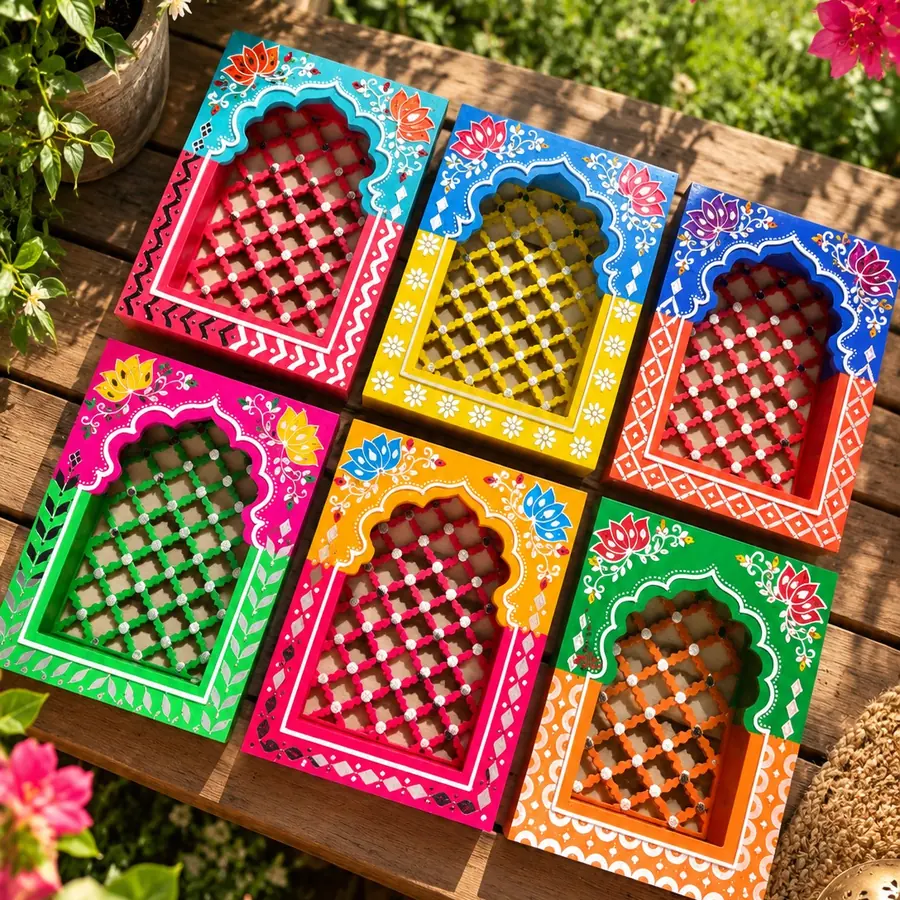
Jharokha frames as wall decor
A jharokha works on a wall the way a window works in a room. It gives the eye somewhere to go, and because the jaali screen is pierced, the wall colour behind it becomes part of the piece.
That makes it unusual among the things I make. Most wall decor sits on the wall. A jharokha frames it.
As wall decor it suits a tall or empty stretch better than a single square panel does, especially a stairwell or a long corridor where you want something to carry the height.
People usually come to this looking for jharokha wall decor rather than for a window frame, which is fair, because that is what it has become.
What a jharokha was for
The jharokha served two purposes at once in haveli architecture. It let air move through a room in a hot climate, and its pierced jaali screen let the women of the house watch the street without being seen from it.
The arch, the bracket supports and the lattice are all structural ideas before they are decorative ones — which is why the shape still reads as architecture even shrunk down to something that hangs on a wall.
Made as a set or a single piece
A set of six in different colours makes a grid that works as a whole wall arrangement. A single larger piece works better above a console or in a narrow stretch of wall between doors.
Each frame is painted by hand, so the floral borders and dot patterns differ slightly between pieces even in one set. That is the point of buying handmade — a printed set would be identical six times over.
What goes behind the opening
A jharokha frames a hole. That is the thing that makes it different from every other piece on this site, and it is the question people forget to think about until the frame is on the wall.
Left as it is, you see your own wall through the jaali. On a plain painted wall that works and is the most common choice, because the lattice reads as a screen with light behind it, which is what the original did.
A mirror cut to the opening and fixed behind the frame is the version that changes the piece most. It turns a decorative frame into something that works as a window, reflecting the room back and doubling the apparent depth. On a dark or narrow corridor wall this is the single most effective thing you can do with a jharokha, and it is worth asking for at the time of ordering rather than retrofitting, because the opening and the mirror need to be cut together.
Painting the wall behind it a contrasting colour is the cheapest option and badly underrated. A deep green or a terracotta patch slightly larger than the frame, with the jharokha hung over it, gives the lattice something to read against and costs a tester pot.
A photograph or a small print behind the opening works in principle and rarely in practice. The jaali breaks the image into fragments and you end up with something you can see but not look at.
The one arrangement to avoid is hanging a jharokha over a textured or patterned wall. The lattice and the texture compete, and at a distance both turn to noise.
Getting a set hung straight
Arches align at the top. Brackets do not align at the bottom.
That is the whole problem with hanging these as a set, and it catches people who have hung picture frames all their lives without trouble. A jharokha is not a rectangle. The arch at the top is regular, the support brackets underneath are shaped and their lowest points differ slightly from piece to piece because they are carved and painted by hand.
So align the tops of the arches and ignore the bottoms. A set hung on a consistent top line reads as deliberate even where the bracket feet sit at slightly different heights. A set hung on centres, which is what you would do with square frames, looks subtly wrong in a way most people cannot name when they look at it.
Spacing wants to be tighter than for flat work. Jharokhas are visually open, so a gap that would feel right between two solid panels leaves a set looking scattered. Somewhere around 10 to 14cm between frames holds a group of six together.
For a grid rather than a row, keep the columns on the same vertical and accept that the horizontal lines will be approximate. The eye forgives a few millimetres vertically far more readily than it forgives a wandering top line.
Tell me the wall measurement when you order and I will tell you how many pieces fit and at what spacing, which saves measuring the wall twice.
Colours and arrangement
The bright multi-colour sets are the most popular, and they suit a neutral wall where the colour has room to work. If your room is already busy, a set in two or three related colours reads calmer while keeping the shape.
Tell me the wall size and I'll tell you how many pieces will fill it properly and how they should be spaced.