The difference
Lippan art and mandala art are not the same kind of thing
People ask me this most weeks, and the question itself has a small mistake buried in it. Lippan and mandala are not two crafts competing for your wall. One is a material technique and the other is a shape. You can have a mandala that is not Lippan, and you can have Lippan that is not a mandala, and the thing most people are actually looking at is both at once.
Made to order in Sector 67, Gurugram · from ₹700 · shipped across India & worldwide
The short version
A mandala is a pattern. Concentric, symmetrical, built outward from a centre point. You can draw one in pencil, paint one on canvas, tile one in a floor, or press one into wet clay.
Lippan is a technique. Clay is raised by hand into lines on a surface, and small mirrors are set into those lines while the clay still moves. It comes from Kutch, in Gujarat.
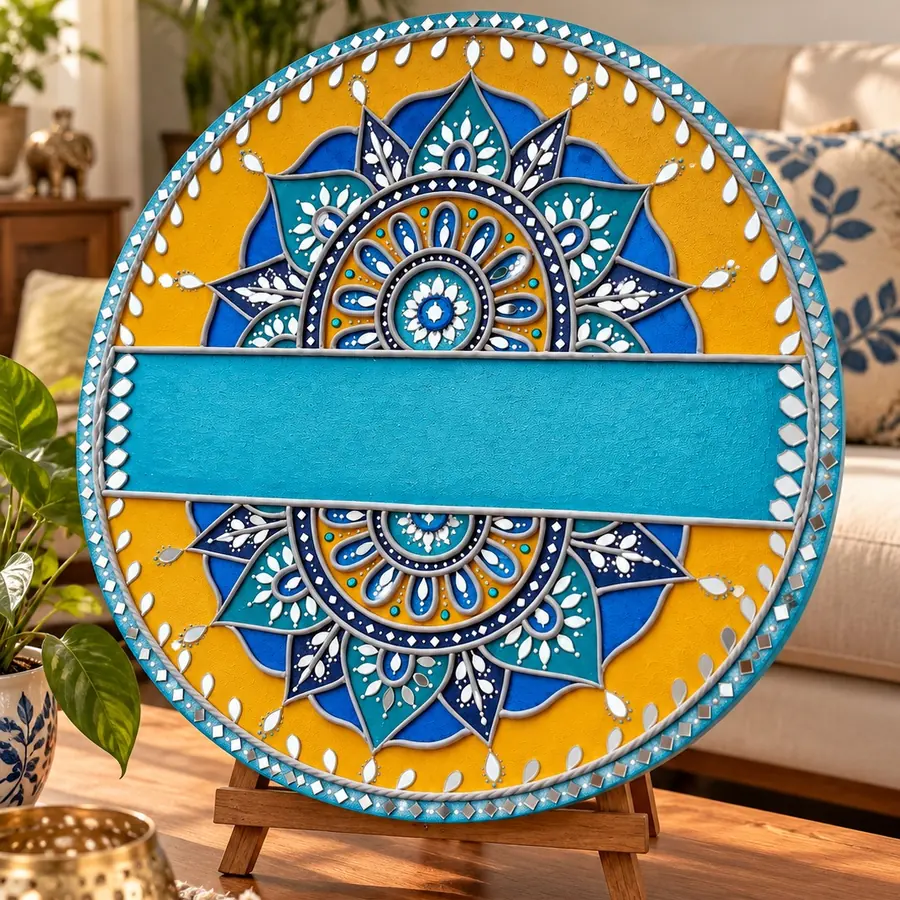
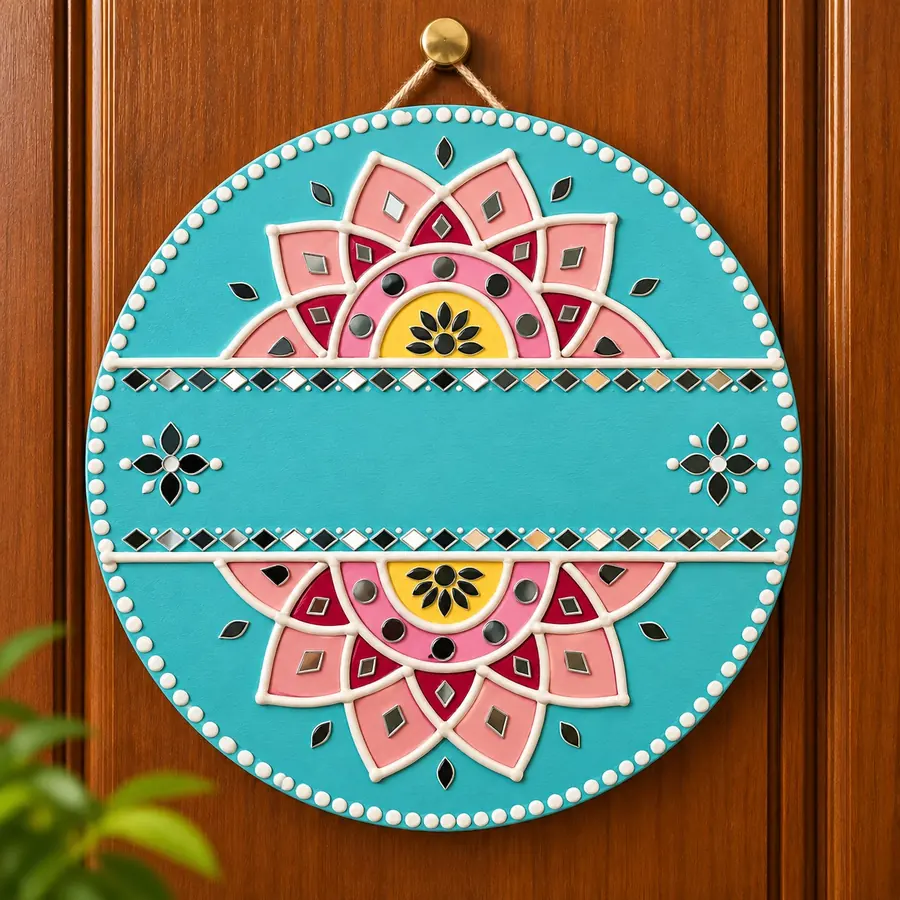
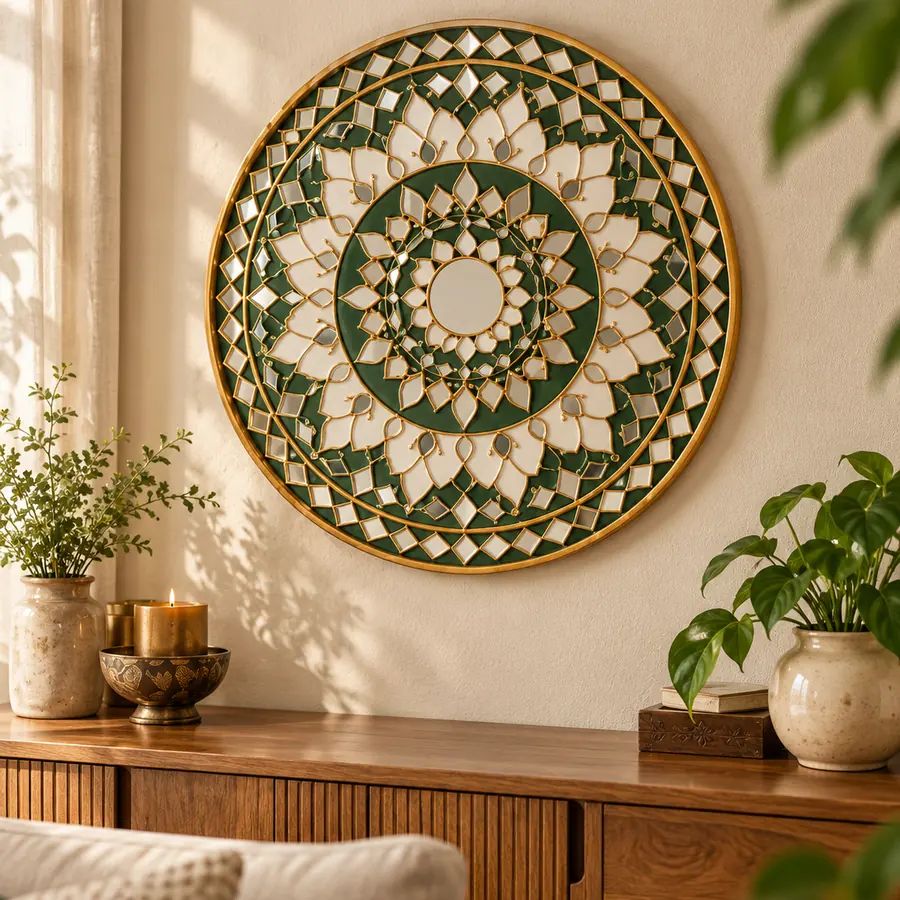
So the two words answer different questions. Mandala tells you what shape the piece is. Lippan tells you what it is made of and how it was built. A round Lippan mandala is both.
That is the whole answer. The rest of this page is why the confusion happens and what it means when you are choosing something.
Where the mandala comes from
The form is old and it is not only Indian. Mandalas appear in Hindu and Buddhist practice as diagrams of the cosmos, used to focus attention during meditation. The word is Sanskrit for circle.
What makes a mandala a mandala is the structure: a centre, then rings of repeating motif worked outward, with the whole thing balanced across its axes. Fold it in half and the halves agree.
None of that says anything about material. A sand mandala made by monks and swept away the same day is a mandala. So is a mandala printed on a cushion cover. The form travels across every medium it touches.
Where Lippan comes from
Lippan kaam belongs to Kutch, the dry western edge of Gujarat. It was worked onto the inside walls of bhungas, the round mud houses of the region, by the communities who lived in them. The Rabari, the Mutwa, the Meghwal.
The word comes from lip, meaning to plaster or to smear, which is exactly what the hand does. Clay is laid down in raised lines, and abhla, small mirrors, are pressed into the clay before it sets.
It was practical first. The relief gave some insulation against the heat. The mirrors multiplied the light of one oil lamp around a room that had no other source after dark. The decoration and the function were the same thing.
So why does everyone confuse them
Because the mandala is the single most requested design in Lippan, by a wide margin. If you search for Lippan art you will see mandalas, and if you search for mandala wall art in mirror work you will see Lippan.
There is a reason the pairing works so well. Lippan is built outward by hand, one line at a time, and a concentric symmetrical form is the easiest kind to keep true when you are working that way. The centre anchors everything. A rectangular narrative scene is much harder to keep in balance.
The mirrors also have more to do in a mandala. Light hits a ring of mirrors set at slightly different angles and the piece changes as you walk past it. On a flat painted mandala, nothing moves.
A mandala on paper and a mandala in Lippan
Put the two side by side and the difference is immediate. The painted one is flat and the detail is in the line work, which can go very fine. Some painted mandalas carry detail no clay line could hold.
The Lippan one is raised. You can run a finger over it and feel every ring. It reads from across a room because of the shadow the relief throws, not because of the detail.
The painted one is light and easy to hang. The Lippan one is heavy, needs a proper fixing, and will not survive a damp wall.
Neither is better. They do different jobs. If you want detail, paint. If you want the piece to change through the day, clay and mirrors.
How I make one
The design goes down first, drawn out on the board before any clay is laid. Once the relief is on, it is on. Raised lines do not move.
Then the lines are built up by hand, working outward from the centre so the rings stay true. This is slow and it is the part that decides whether the finished piece looks right.
Mirrors go in while the clay is still workable, each one pressed and seated so the clay comes up to hold its edge. Glued-on mirrors sit proud of the surface and you can see it.
Then it dries. Properly, in layers, with each one hard before the next goes on. That is what sets the timeline and it is the step that cannot be rushed. A piece hurried through drying cracks about a year later, usually at the thickest point.
Can a mandala be made in something other than Lippan
Yes, and I make some of them. Dot art mandalas are painted with the point of a tool rather than a brush, building the pattern from thousands of raised dots of paint. They are lighter than clay and the colour range is wider.
There are metal mandalas, carved wooden ones, and mandalas worked in thread. None of those are Lippan and none of them are wrong.
So the real choice is which material you want your mandala in.
Spotting a machine-made one
Look at the mirrors first. In hand-set work the clay rises to meet the mirror edge and holds it. In cast or moulded work the mirror sits on top, often with a visible ring of adhesive around it.
Then look along a raised line. A hand-laid line varies slightly in width as it travels, because a hand is doing it, but it holds a consistent height. A moulded line is perfectly even in width and often slightly soft at the edges.
Flip it over if you can. A piece made to be sold rather than made for somebody is usually unfinished on the back.
Price is the weakest signal of the four. Plenty of genuinely handmade work is cheap because the maker is underpaid.
Which suits your wall
A round mandala wants a wall with space around it. It is a centred form and it looks wrong crammed into a corner or squeezed between two door frames.
If the wall gets changing daylight, Lippan earns its place, because the mirrors have something to work with. On a wall in permanent shade you lose most of what you are paying for, unless you put a lamp across it.
For a small wall or a narrow run, a mandala is often the wrong call entirely and a horizontal geometric border does the job better.
Send me a photo of the wall with the measurements and I will tell you which of those applies.
Looking after a clay mandala
Dust it with a dry brush rather than a cloth. A clean paintbrush gets between the rings without snagging on the mirror edges.
No damp cloth on the clay, ever. If a mirror needs cleaning, a barely damp cotton bud on the glass itself is as far as I would go.
If a mirror lifts, keep it. Do not throw it away and do not glue it back yourself. Send me a photo and in most cases it can be reset.
What a mandala costs to make, in hours
The honest unit here is time, not size. A 45cm mandala with five rings and sixty mirrors is more work than a 70cm panel with three rings and twenty.
Every ring has to be laid at a consistent height or the symmetry breaks, and the eye catches that immediately in a circular form. On a rectangular panel a wobble hides. On a mandala it does not.
Mirror count is the other driver. Each one is placed and seated individually, and the small ones take longer per mirror than the large ones.
So when I quote, I am pricing the ring count and the mirror density first and the dimensions second. People find that counter-intuitive until they watch a piece being made.
Mandalas in other Indian crafts
Rangoli is the one everybody knows. The form is the same, built outward from a centre in coloured powder, and it is swept away at the end of the festival. The impermanence is the point.
Kolam in Tamil Nadu works on a dot grid and is drawn fresh each morning at the threshold.
Dot art mandalas, which I also make, use raised points of paint rather than clay. They are lighter, the colour range is wider, and they suit a piece that needs to travel.
Each of those is a mandala and none of them is Lippan. If somebody tells you mandala art means one specific technique, they are describing whichever one they happen to sell.
Which one is right for a gift
Mandalas gift well across almost any occasion, which is their main advantage over something like Madhubani where the motif carries a specific meaning.
For a housewarming they work without presuming anything about the recipient's taste or faith. For a wedding the symmetry reads as balance, which people like.
If you want the piece to say something particular, a mandala is the wrong choice and you want Madhubani instead, where fish and lotus and kohbar all mean something you can explain.
I keep a note of which it is when somebody orders, because the two conversations go in different directions.
Having one made
Everything here is made to order, so the ring count, the mirror density and the colours are decided for your wall rather than picked from stock.
Within India pieces start at ₹700. For orders going abroad the floor is ₹3,500, roughly US$37, €33 or £28 at October 2026 rates, with delivery quoted separately.
Detailing moves the price more than size does. A small densely worked mandala can take longer than a larger simple one, because every ring is laid by hand and every mirror set on its own.
Questions before ordering
Is mandala art the same as Lippan art?
Can you make a mandala in Lippan?
Which is older, mandala or Lippan?
Is a Lippan mandala more expensive than a painted one?
What does the mandala pattern mean?
Can I have a mandala in my own colours?
Is a mandala a good choice for a small wall?
How do I tell a handmade mandala from a moulded one?
Do you ship a mandala piece abroad?
How do I clean a Lippan mandala?
More from this collection