Gifting abroad
Giving Indian craft to someone unfamiliar with it
A friend in Munich opens a box containing a clay panel with mirrors set into it. She likes it, she says thank you, and she has no idea what she is holding. That gap is the whole problem with gifting craft across a cultural line, and it is not solved by buying something more impressive. It is solved by giving her something to say about it when a visitor asks.
Made to order in Sector 67, Gurugram · from ₹700 · shipped across India & worldwide
The object is not the gift
What you are actually giving is a thing plus a story, and the story is the part that makes it theirs rather than just a nice object from somewhere else.
Without it the piece sits on a shelf as decoration. With it, it becomes the thing they bring up when someone visits, which is a much better outcome for a gift.
So decide what you are going to tell them before you decide what to buy.
Lippan, in one sentence
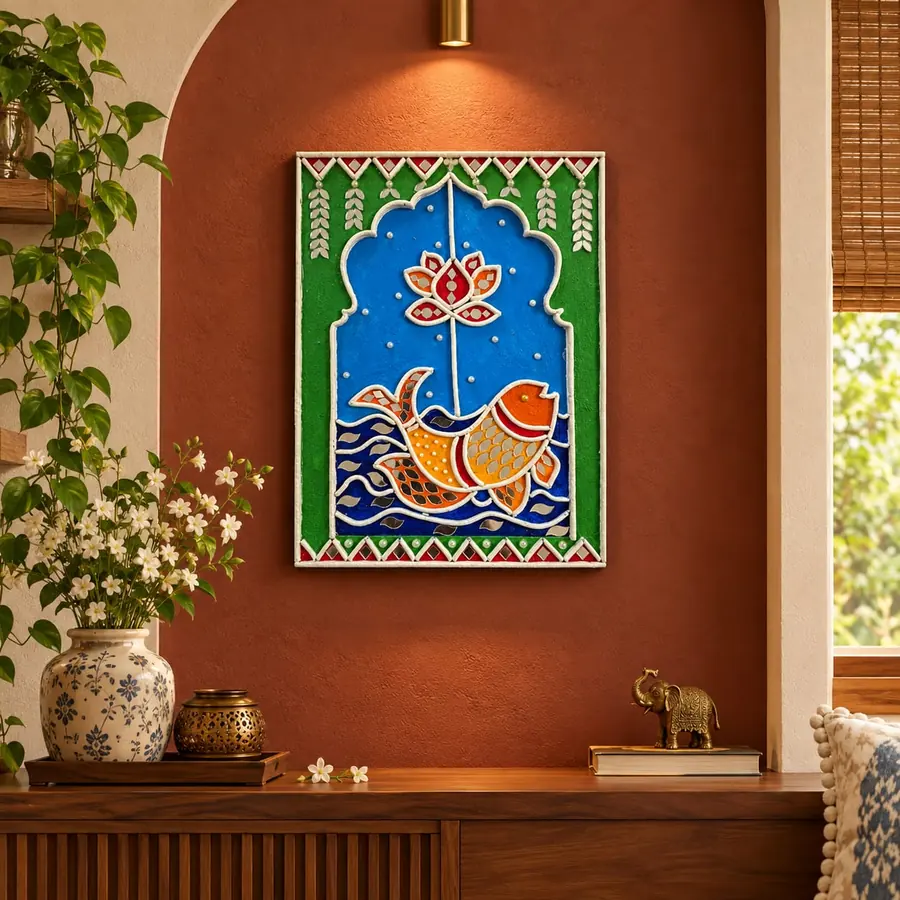
Here is the version I give people: it is clay relief with small mirrors set into it, from the desert region of Kutch in Gujarat, where it was worked onto the inside walls of round mud houses so one oil lamp could light the whole room.
That is enough. It has a place, a material, and a reason, and nobody needs more than that at a dinner party.
If they want more, the detail is on this site and you can send them a link.
The other three, equally short
Pichwai: devotional cloth panels from Nathdwara in Rajasthan, hung behind the idol in a temple. The name means behind and hanging.
Madhubani: a painting tradition from the Mithila region of Bihar, painted by women on house walls for weddings, where every motif carries a meaning.
Jharokha: the overhanging carved window of a Rajasthani haveli, where you could watch the street without being seen.
Each of those is one sentence and each one answers the question somebody will actually ask, which is what is it and where is it from.
Pieces that explain themselves
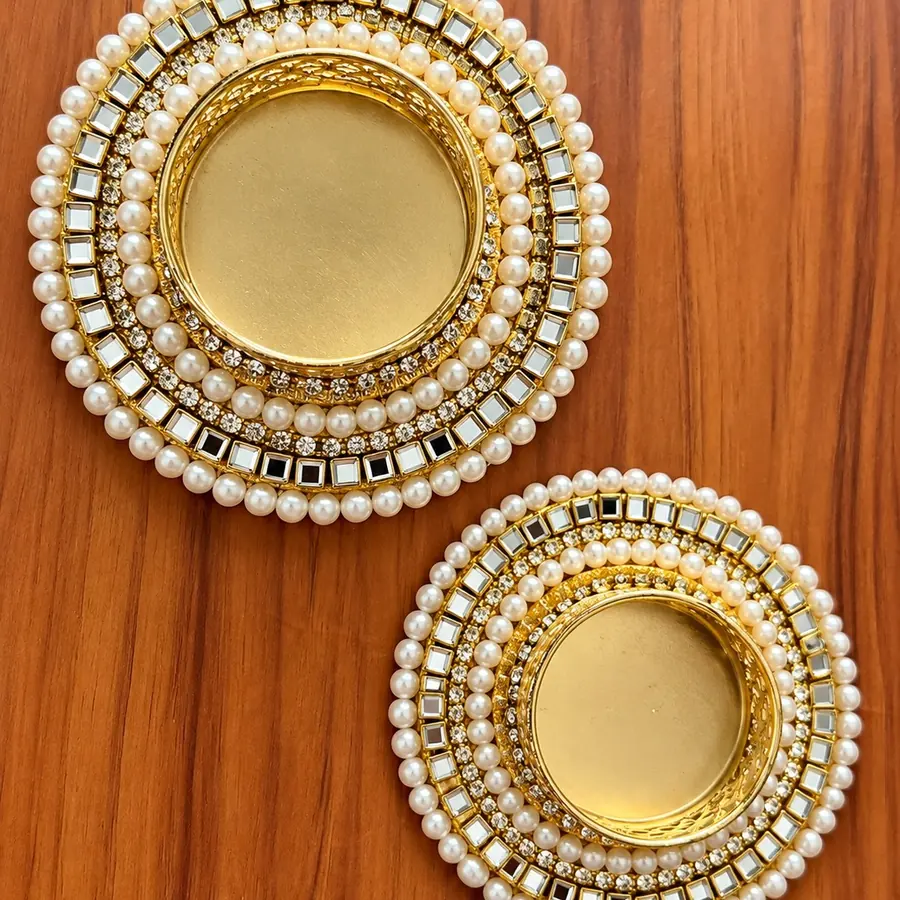
Some things need no translation. A tea light holder is a tea light holder in any country, and the mirror work explains itself the moment a candle goes in it.
Candle plates, coasters and anything with an obvious use land easily, because the recipient knows what to do with it on day one.
A wall panel is harder, because it requires them to give up a wall for something they do not yet understand. For a first gift to someone with no context, I would usually go functional.
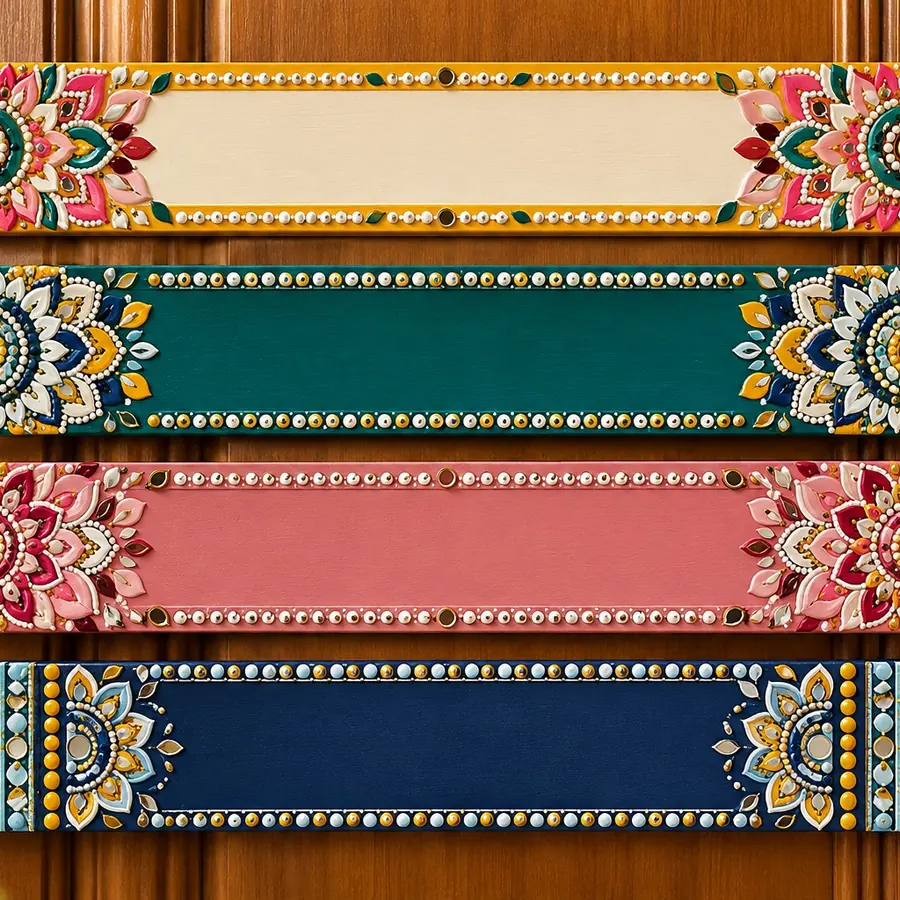
A name plate with their name on it is the exception. That needs no cultural explanation at all, because it is obviously about them.
When the motif is the gift
Madhubani is a language of symbols and that makes it the strongest choice when the occasion means something. Fish for fertility and good fortune. The lotus for purity. The kohbar for the marriage chamber.
If you tell me what the occasion is, I will choose the motif on purpose rather than decoratively, and you can tell them why it is that fish and not another one.
That turns a gift into something that was clearly thought about, which is most of what a gift is supposed to do.
What tends to land badly
Anything that requires the recipient to redecorate. A large panel in a strong colour is a demand dressed as a present.
Anything heavy, if they move often. People in their twenties and thirties abroad move a lot.
Something bought because it is impressive rather than because it suits them. The impulse to send the biggest thing is understandable and it is usually wrong.
A piece with no note. See below.
Religious imagery, carefully
A Ganesha piece given to a Hindu friend abroad is a thoughtful gift. The same piece given to someone of another faith, or none, can be awkward in a way they will be too polite to mention.
The test I use: would they display it, or would they feel they had to display it? If it is the second, pick something else.
Geometric and floral work sidesteps this completely and still carries the craft. A mandala is a form, not a claim.
If you are not sure, ask me and I will steer you away from the devotional end.
Include a note
Two or three lines. What it is, where the craft comes from, and why you picked that one for them.
Send me the wording and I will include it with the piece. People keep these. I have had customers tell me the note ended up framed next to the work.
If you want the piece sent directly to them rather than to you, say so and I will pack it to be handed over rather than unwrapped and re-wrapped.
Getting it there
Pieces go to the USA, the UK, Canada, Australia, the UAE and across Europe. Smaller and framed travels better than large and unframed, which matters more for a gift than for your own wall.
For orders outside India prices start at ₹3,500, roughly US$37, €33 or £28 at October 2026 rates. Delivery is charged on top and quoted for the address.
Customs is set by their country, not by me, and a customs bill arriving with a present is the one outcome worth planning around. Tell me which country it is going to and I will tell you what currently applies before you commit.
Weight, shipping and what it costs to send a gift
A 30cm framed piece is a straightforward parcel. A 70cm unframed panel is a problem, and the delivery can approach the cost of the piece.
For a gift going abroad I would put the budget into the piece and keep the size down, rather than the other way round.
Delivery is charged on top and quoted for the address, so ask before you settle on a size. The answer changes what I would suggest making.
Timing it to arrive
Making time plus transit, and both of them matter. Tell me the date it needs to land on rather than the date you are messaging me.
Festival season here is the slowest period, which is also when most people want gifts sent. Ask early rather than in the final fortnight.
If the date is not achievable I will say so at the start, and there is usually a smaller piece that can be done properly in the time.
Gifting to family versus gifting to friends
Indian-origin families abroad already know what Lippan is, and the gift works differently. It carries a connection to a place rather than an introduction to a craft.
For them, a piece from a named studio in Gurugram means more than a piece from a marketplace, and it is worth saying where it came from.
For a friend with no connection to India, the craft is new information and the piece has to stand on whether they like it, not on what it represents.
Occasions that translate, and ones that do not
A housewarming is universal. So is a wedding, a new baby, a birthday.
Diwali travels reasonably well as a reason to send something, even to people who do not mark it, because the lamp-and-light idea needs no explanation.
Karva Chauth, Bhai Dooj and Chhath do not travel without a paragraph of context, and a gift that needs a paragraph is working too hard.
What they will ask you
How long did it take to make. The honest answer is that drying between layers sets the time, not the painting.
Whether the mirrors are real glass. They are, and they are set into the clay rather than glued on top.
Where it came from. Gurugram, made by one person.
How to clean it. A dry soft brush, never a damp cloth on the clay. Tell them that on day one and the piece will outlast them.
Questions before ordering
What is a good Indian gift for a friend who is not Indian?
How do I explain Lippan art in one sentence?
Is religious imagery appropriate as a gift abroad?
Can you include a note with the gift?
Can you send it directly to them?
Which piece travels best?
What does it cost in dollars or euros?
Will they have to pay customs?
More from this collection