Buyer's guide
Choosing Indian wall art for your room
Most people choose a piece they like and then discover it is the wrong size for the wall, or that the colours fight the room. This guide goes the other way round — wall first, piece second. I make Lippan, Pichwai, Madhubani and Jharokha work to order from a studio in Gurugram, so this is written from the measuring, making and hanging end of it rather than from a catalogue.
Made to order in Sector 67, Gurugram · from ₹700 · shipped across India & worldwide
Start with the wall, not the piece
Measure the wall you actually want to fill, then the furniture under it. The usual mistake is buying something too small, which leaves a piece stranded in the middle of a large wall and makes the whole room look unfinished.
A reliable starting point above a sofa or console is a piece about two-thirds the width of the furniture below it. Above a three-seater sofa of around 210cm, that puts you near 140cm of artwork — either one large piece or a group that reads as one.
Hang the centre of the piece at roughly eye level when standing, which for most people falls around 145 to 150cm from the floor. Above furniture, leave a hand's width of clear wall between the top of the furniture and the bottom of the frame so the two read as one group rather than colliding.
Write those three numbers down before you look at any artwork: wall width, furniture width, and the height from the floor to the top of the furniture. Almost every sizing question can be answered from them.
A worked example
Say the wall is 300cm wide, the sofa is 210cm, and the sofa back is 80cm high.
Two-thirds of 210 is 140, so you are looking for roughly 140cm of artwork width. That could be one panel at 140cm, two at 65cm with a gap, or three at 40cm.
The bottom of the artwork wants to sit about 15 to 20cm above the sofa back, so around 95 to 100cm from the floor. If the piece is 90cm tall, its top lands near 190cm, which is comfortable under a standard ceiling.
The remaining 80cm of wall splits as 40cm of breathing room each side. That is what stops the group looking cramped, and it is the part people forget to leave.
Which tradition suits which room
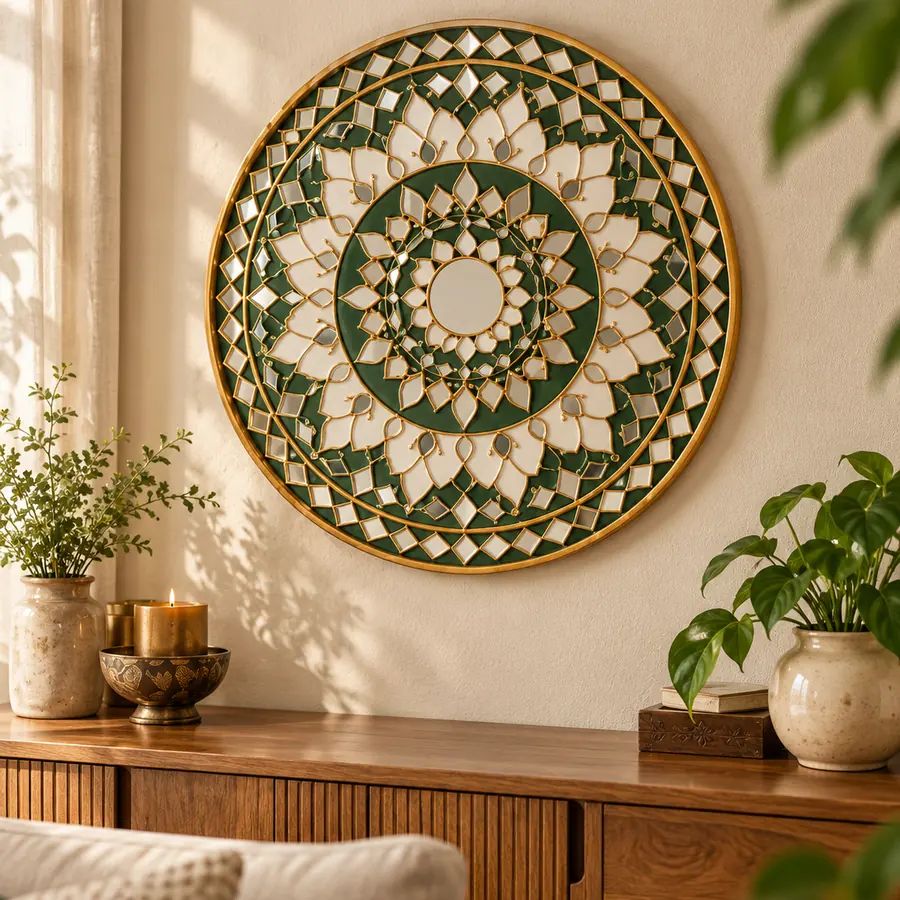
Lippan is raised clay with mirrors set into it. It changes through the day as the mirrors pick up whatever light the room has, and it is restrained in colour. It suits a room that already has enough colour, and a wall that gets some daylight.
Pichwai is devotional and strictly symmetrical, built around lotuses, cows, peacocks and decorated elephants. It carries a formal, composed feeling, and it suits a space you want to feel considered rather than casual — a dining wall, a landing, a pooja room.
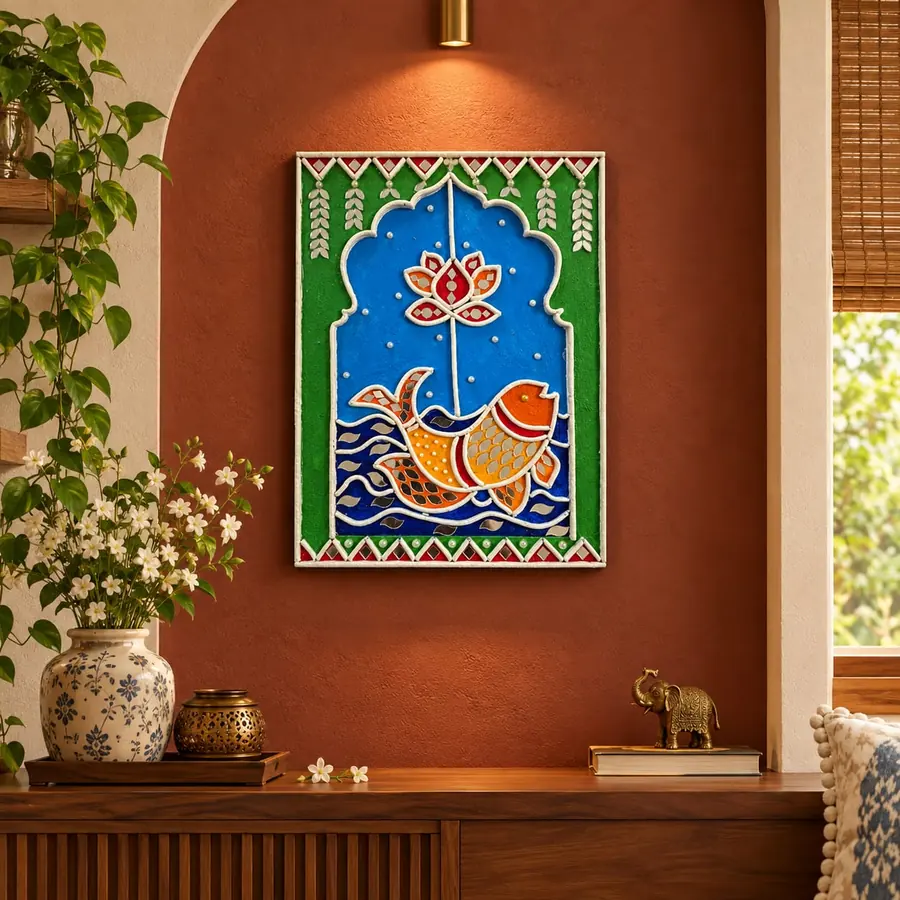
Madhubani is strong colour and a language of symbols: fish for fertility and good fortune, the lotus for purity, the kohbar for the marriage chamber. It suits a plainer room, and it gives you a subject rather than a pattern, which matters if the piece is a gift for a particular occasion.
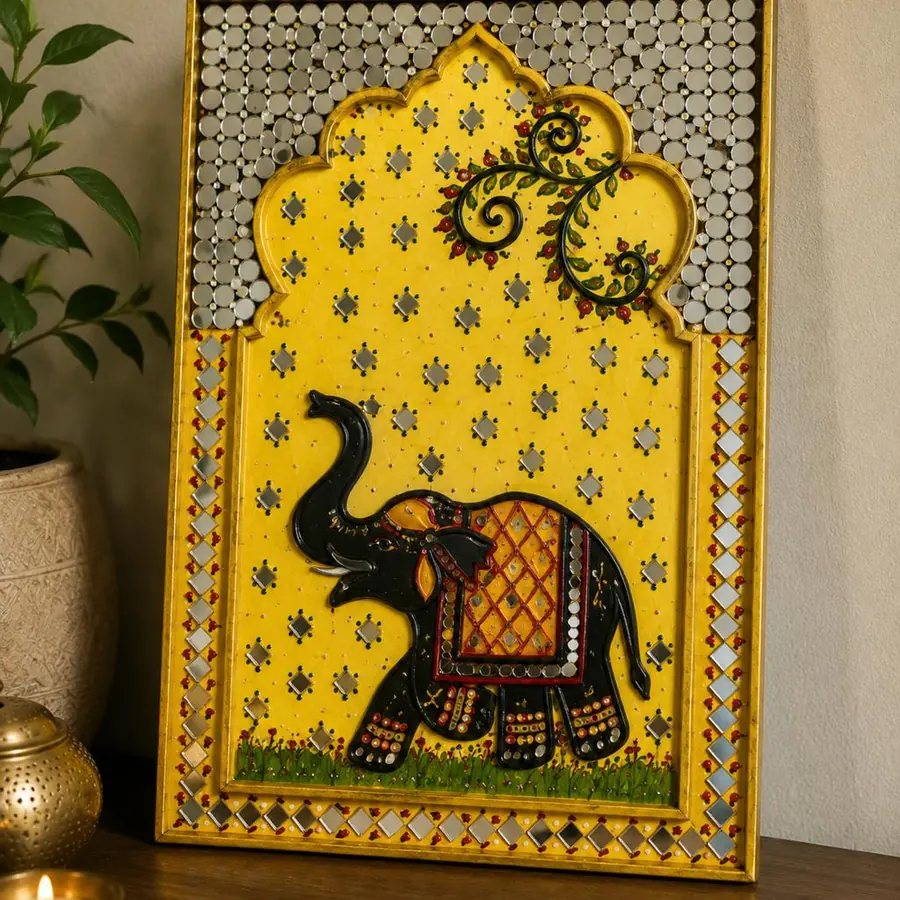
Jharokha frames are architectural — an arched haveli window with a pierced jaali screen. They work best in a group, and they break up a tall empty wall or a stairwell better than a single piece does.
Room by room
Living room. The largest wall usually wants one confident piece rather than several small ones. This is where Lippan earns its keep, because the light changes across the day and the piece changes with it.
Entrance or hallway. People pass close, so detail is read properly. A round mandala or a name plate works here, and an entrance piece sets the tone for everything behind it.
Bedroom. Above the bed, go wide and low rather than tall. Keep the palette quieter than you would in a living room — you are looking at it last thing at night and first thing in the morning.
Dining room. Symmetry suits a dining wall, which makes Pichwai a natural fit. Avoid anything so detailed that it competes with the table when it is laid.
Pooja room or prayer corner. Pichwai carries the traditional association most directly. Keep the scale modest; this is not the wall for a statement piece.
Stairwell. A vertical group of three or four smaller pieces follows the rise better than one large panel, and Jharokha frames were made for exactly this kind of arrangement.
Home office. Behind you, something simple that reads well on camera. In front of you, something you will not tire of.
One statement piece or a group
A single large piece is calmer, easier to hang and easier to get right. If you are unsure, this is the safer choice and the one I recommend most often.
A group gives you flexibility and is easier to build up over time, but it needs a rule to hold it together: either a shared palette, a shared spacing, or a shared shape. Without one of those it reads as clutter.
If you group, keep the gaps consistent — 5 to 8cm between pieces usually works — and align either the tops or the centres. Do not try to align both.
Mixing traditions in one group can work, but give them something in common. Four Jharokha frames in one palette hold together; a Lippan mandala next to a Madhubani panel usually does not, because one is texture and the other is colour.
Getting the colour right
Pull two colours out of the room — usually one from the largest soft furnishing and one from the wood or metal in the space — and ask for those rather than describing a mood. "Warm" means something different to everyone; a photo of the sofa does not.
Against a pale wall, a darker ground with mirror detail reads clearly from across the room. Against a dark or strongly coloured wall the reverse is true, and a lighter piece will carry further.
Traditional Lippan was white clay on a dark ground, and that combination still works better than most. If you are stuck, it is a safe place to start.
Because every piece here is made to order, colours are chosen at the beginning rather than picked from stock. Send a photo of the wall and the room will usually answer the question faster than a list will.
Indian art in a modern interior
These crafts are often assumed to need a traditional Indian room. They do not, and some of the best results come from the opposite.
In a minimal or Scandinavian space, a single Lippan mandala in white or clay tones works as texture rather than as decoration. The restraint of the palette is doing the same job as the rest of the room.
In a mid-century or wood-heavy interior, the warm terracottas and greens of Lippan sit comfortably with teak and walnut, and mirror work picks up brass and bronze fittings.
In a colourful or maximal room, Madhubani holds its own where a quieter piece would disappear.
The one combination to be careful with is a room that already has a lot of pattern. Relief and mirror work is itself a pattern, and two competing patterns on adjacent surfaces rarely settle.
Lighting the piece
Mirror work is designed to do something with light, so where the light comes from matters more than how much there is.
Light raking across the surface at an angle is far better than light hitting it straight on. Straight-on light flattens the relief and kills the shadow that makes it read as three-dimensional.
A wall opposite or adjacent to a window gives you changing daylight, which is the best version of this. A picture light or an angled spot does the same job after dark.
Avoid lighting it from directly below unless you want the texture exaggerated, which occasionally is the point.
Framed or unframed
An unframed panel reads as more contemporary and lets the relief run to the edge. It suits a minimal room and a single statement piece.
A frame gives the piece a defined boundary, protects the edges in transit and on the wall, and helps a smaller piece hold a larger wall. Framing adds to the price.
For a group, framing consistently is usually what makes the group read as one thing.
Tell me at the design stage rather than afterwards — a piece is built differently depending on whether it will be framed.
Hanging relief work safely
Clay relief with mirror work is heavier than a canvas of the same size, and the weight is spread across the whole panel rather than concentrated at the frame.
Use a fixing rated well above the actual weight of the piece, and fix into masonry or a stud rather than into plasterboard alone. A plasterboard anchor rated for the load is the minimum; two fixings spread across the width are better than one in the middle.
Two fixings also stop the piece rotating slowly out of level, which is what happens with a single central hook over time.
Keep it off walls that get direct, prolonged sun if you can. It will not damage the clay quickly, but strong sun fades painted colour over years in any medium.
Let a newly delivered piece sit indoors for a day before hanging if it has travelled somewhere much colder or damper than it was made.
Where not to put it
Not a bathroom, and not a kitchen wall directly behind a hob. Lippan is clay, and steady moisture and steam will damage the relief. This is the single most common mistake and it is not recoverable.
Not an open balcony, gate, porch or any wall exposed to rain. These are interior pieces and nothing changes that.
Not a wall that gets washed down regularly, and not immediately above a radiator or heating vent where the air is repeatedly dried and reheated.
If you tell me where a piece is going and it is somewhere it should not be, I will say so before you order rather than after.
Common mistakes
Buying too small. By far the most frequent, and the hardest to fix afterwards.
Hanging too high. Art drifts upward when people hang it at their own eye level while standing on a stool.
Choosing colour from a screen. Screens are backlit and your wall is not. Work from a photo of the room instead.
Forgetting the fixing. Deciding how to hang a heavy relief piece after it has arrived rather than before.
Leaving no breathing room. A piece that fills a wall edge to edge looks like it was installed rather than chosen.
What it costs, and why it varies
Within India, pieces start at ₹700. Orders going outside India start at ₹3,500 — see the international section below. What you pay above that depends on three things: the size, how much mirror and clay detailing the design needs, and whether it is framed.
Detailing matters more than size. A small, densely worked mandala can take longer than a larger, simpler panel, because every raised line is laid by hand and every mirror is set individually.
That is also why two pieces of identical dimensions can differ in price. You are paying for hours of hand work, not for surface area.
You see a firm price alongside a design direction before anything is made, and nothing is started until you have approved both.
Looking after it
Dust with a dry, soft brush — a clean paintbrush is ideal for getting between raised lines. Do not use a damp cloth on the clay.
If a mirror ever lifts, keep it and send me a photo. A single mirror can usually be reset; it is not a reason to replace a piece.
Do not hang it where it will be knocked repeatedly, such as behind a door or along a narrow corridor at shoulder height.
Indoors and away from moisture, these last indefinitely. The tradition survived on the interior walls of Kutch houses for centuries, which is a reasonable durability test.
Ordering from outside India
Pieces ship from the studio in Gurugram to the USA, the UK, Canada, Australia, the UAE and across Europe, as well as anywhere in India.
Prices are set in rupees. For orders outside India, pieces start at ₹3,500, which is roughly US$37, €33 or £28 at October 2026 rates. The exact figure in your currency is confirmed with your quote, because rates move.
Delivery is charged separately on top of that, and the amount depends on the destination country as well as the size and weight of the piece. You get the delivery cost with your quote rather than at checkout.
Shipping cost and transit time depend on the size and weight of the piece and on the destination, so they are quoted per order rather than published as a flat rate. Ask before you commit and you will get a real number.
Customs duty and import VAT are set by the destination country, not by the studio. Rules changed in both the USA and the EU during 2025 and 2026, so ask me what currently applies to your country before ordering rather than assuming the old position.
Relief work with mirrors is fragile, so a smaller framed piece travels better than a large unframed panel. If you are ordering from abroad, say so at the design stage and it changes what I would recommend making.
A short glossary
Lippan, or lippan kaam — the mud-and-mirror relief craft of Kutch in Gujarat. The word comes from lip, meaning to plaster or to smear.
Abhla — the small mirrors set into the clay relief.
Bhunga — the round mud house of Kutch, where the craft was originally worked onto interior walls.
Pichwai — literally behind (pichh) and hanging (wai); cloth panels hung behind the idol of Shrinathji at Nathdwara.
Jaali — the pierced lattice screen in a jharokha window.
Kohbar — the Madhubani composition painted for the marriage chamber.
Questions before ordering
What size wall art do I need above a sofa?
How high should I hang wall art?
Can handmade Indian wall art go in a bathroom?
How heavy is Lippan art, and how should it be hung?
Does Indian wall art work in a modern or minimal interior?
Should I buy one large piece or a group of smaller ones?
Can I get a piece in specific colours to match my room?
How much does handmade Indian wall art cost?
Do you ship Indian wall art to the USA, the UK or Europe?
Does the price include delivery?
How much is it in dollars, euros or pounds?
Will I pay customs duty or import VAT?
More from this collection