The craft
Mirror work wall décor, explained
People usually find this craft by searching for the look rather than the name — small mirrors set into a raised pattern, catching the light. The mirrors are called abhla, and in the form I make it, the craft is Lippan, the mud-and-mirror work of Kutch. This page covers what it is, how it is made, where it works in a room, how to tell good work from poor, and what it is not.
Made to order in Sector 67, Gurugram · from ₹700 · shipped across India & worldwide
What mirror work actually is
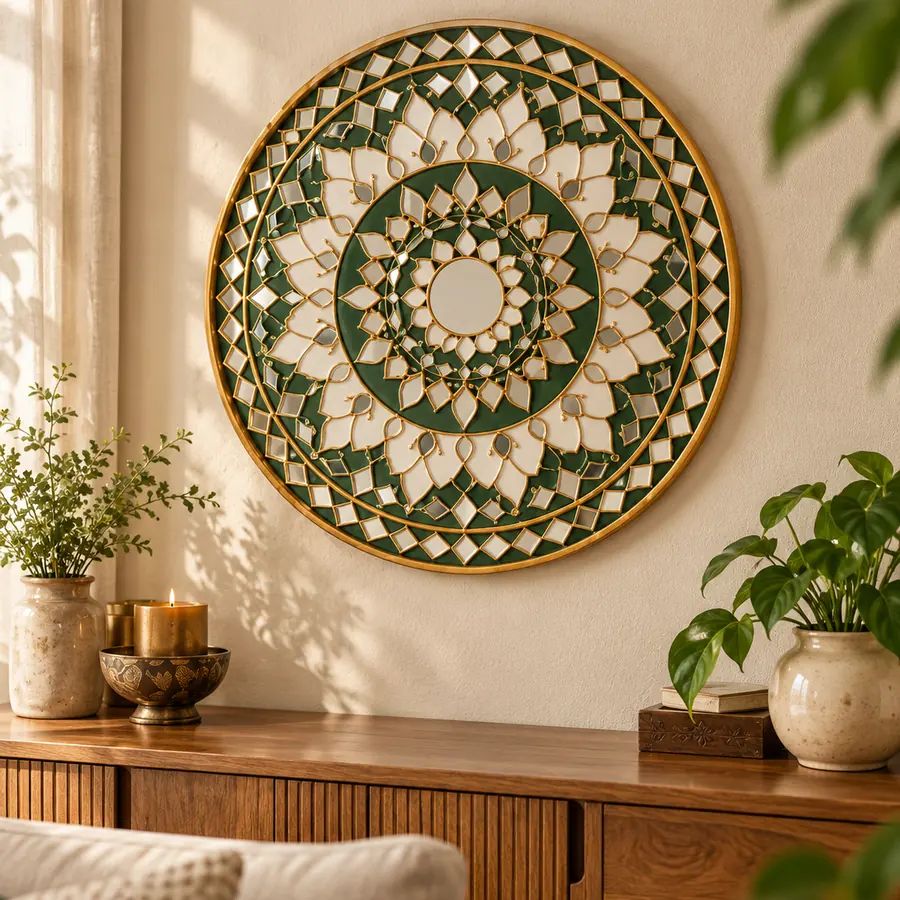
The mirrors are called abhla. They are small pieces of mirror glass set by hand into a raised clay surface while the clay is still workable, so they are held by the relief itself rather than glued onto a flat board.
The pattern around them is built up line by line in clay. This is the lippan — the word comes from lip or lipan in the local dialect, meaning to plaster, to apply or to smear, which describes the process exactly.
The mirrors and the relief are made as one thing, not applied in two stages. That is the difference between genuine mirror work and a decorated surface with mirrors stuck on afterwards.
It comes from Kutch in Gujarat, where it was worked onto the interior walls of bhungas, the round mud houses of the region. Communities including the Rabari, Mutwa and Meghwal have practised it for generations.
Why mirrors, originally
It was practical before it was decorative. The relief gave some insulation against desert heat, keeping interiors cooler in summer and warmer in winter.
The mirrors spread the light of a single oil lamp around a dark interior after sunset. In a house with no electricity, a wall that multiplied lamplight was not ornament — it was lighting.
That origin is still the most useful thing to know when deciding where to hang a piece. Mirror work is designed to do something with light. In a room with no daylight and no lamp near it, you lose most of what makes it worth having.
It also explains why the traditional palette was restrained. White clay on a dark ground reflects most efficiently, and the colour came later as the craft moved from necessity to decoration.
How a piece is made
It begins as a drawing. The design is set out on the board before any clay goes down, because the relief cannot easily be moved once it is laid.
The raised lines are then built up by hand, one at a time. This is slow, and it is the part that determines how the finished piece reads from across a room.
Mirrors are set while the clay is still workable, each one pressed into place individually and seated so the surrounding clay holds its edge.
Each layer must dry fully before the next goes on. A single piece passes through 4 distinct stages — drawing, raised relief, mirror setting, then paint and finish — and the drying between them is the single biggest factor in how long it takes. It is the step that cannot be hurried; rushing it is what makes work crack a year later.
Painting and finishing come last, once the relief is sound. Then the piece is left to cure before it is packed.
Where it works in a room
A wall that gets changing daylight is ideal, because the piece reads differently through the day rather than looking the same from morning to night.
Opposite or adjacent to a window works better than a wall in permanent shade. If the wall is dark, a lamp angled across the piece will do the same job.
Light raking across the surface is better than light hitting it straight on. Straight-on light flattens the relief and removes the shadow that makes it three-dimensional.
An entrance suits it well, because people pass at close range and the detail is actually seen rather than glanced at. Hang the centre at roughly 145 to 150cm from the floor, which is eye level standing for most people.
Not a bathroom and not directly behind a hob. The clay is the limit, not the mirrors — steady moisture and steam will damage the relief.
What it is not
It is not a mirror you can look at yourself in. The pieces are small, set at slightly different angles, and the point is reflected light rather than reflection.
It is not mirrored furniture or mirror-tile wall panelling, which is a different and much more modern look built from large flat glass.
It is not mosaic. Mosaic sets tesserae into a flat grouted bed; mirror work sets mirrors into a raised relief that is itself the design.
It is not printed, moulded or machine-made. Each mirror is set individually by hand, which is also why no two pieces are identical even in the same design.
How to judge quality
Look at how the mirrors are seated. In good work the clay comes up to meet the mirror edge cleanly and holds it; in poor work the mirror sits on the surface with a visible gap or a smear of adhesive around it.
Look at the depth and consistency of the raised lines. Hand-laid relief has slight variation along its length but consistent height. Flat, perfectly even lines usually mean a mould.
Look at the back and the edges. A well-made piece is finished where nobody will look, and the edges are sealed rather than left raw.
Ask what the base is. Traditional work was on a wall; portable pieces are built on board, and the board matters for how the piece survives being moved.
Ask who made it. In a workshop with a production line the answer is vague. Here it is one person, and you can see work in progress before the piece is finished.
Common patterns and what they suit
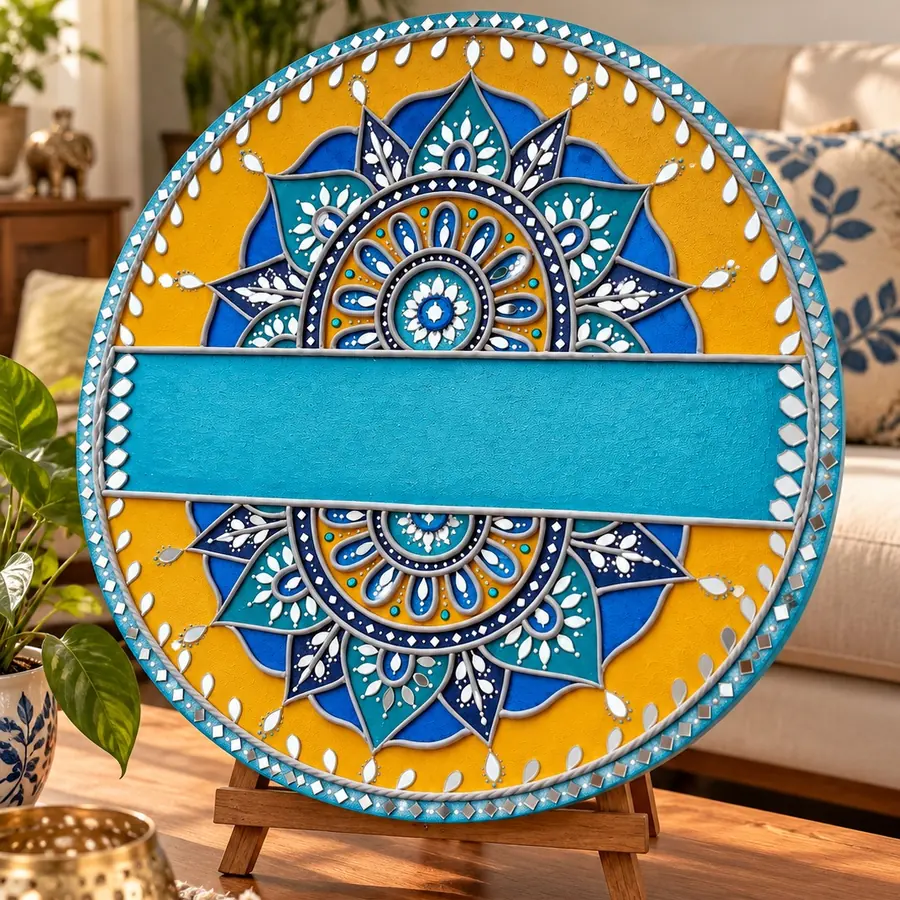
Mandala work is the most requested: concentric, symmetrical, and the form that suits a round piece or a square panel equally. It is the safest choice for a first piece.
Geometric borders and repeating motifs come straight from the traditional wall work. They suit a long horizontal space above a console, a bed or a dining sideboard.
Figurative work — peacocks, lotuses, elephants — is where mirror work overlaps with the painted traditions, and it is where a piece can carry a subject rather than a pattern.
Lettering and name plates are a modern adaptation, and they are the most popular use of the craft for gifts.
Colour, traditional and modern
Traditionally the ground was dark and the clay relief was left white or near-white. It is still the combination that reads most clearly and the one I would suggest if you are unsure.
Modern pieces take colour far more freely — greens, terracottas, blues and golds are all common, and the mirrors work against any of them.
The thing to watch is contrast rather than hue. Mirror work needs the relief to be visibly different from the ground, or the pattern disappears and only the mirrors read.
Because everything here is made to order, the palette is chosen for your wall at the start rather than picked from stock.
Styling it with different interiors
In a minimal or Scandinavian room, a white or clay-toned mandala works as texture rather than as decoration, and the restraint does the work.
In a wood-heavy or mid-century room, warm terracottas and greens sit well with teak and walnut, and the mirrors pick up brass and bronze.
In a colourful room, go larger and simpler rather than smaller and busier, or the piece competes with everything around it.
The combination to be careful with is a wall that already carries pattern — wallpaper, tiling or a patterned textile. Relief with mirrors is itself a pattern, and two rarely settle together.
Having a piece made
Everything here is made to order in your size and colours, so pattern density and mirror count are decided for your wall rather than bought as stock.
More mirror and more raised detailing takes longer and costs more than a simple panel of the same size. Detailing drives the price more than dimensions do.
Within India, pieces start at ₹700, and orders going abroad start at ₹3,500. Either way you see a design direction and a firm price before anything is made.
Send a photo of the wall, the measurements, and a note about the light it gets. The light is the part people leave out, and for this craft it matters more than it does for a painting.
Caring for mirror work
Dust with a dry soft brush rather than a cloth — a clean paintbrush gets between the raised lines without catching on the mirror edges.
Never use a damp cloth or glass cleaner on the clay. If you must clean a mirror, use a barely damp cotton bud on the glass itself and keep moisture off the relief.
Do not hang it where it will be knocked repeatedly, such as behind a door or along a narrow corridor at shoulder height.
If a mirror lifts, keep it and send a photo. It can usually be reset, and a single loose mirror is not a reason to replace a piece.
Indoors and away from moisture, these last indefinitely. The craft survived on the interior walls of Kutch houses for centuries.
Mirror work beyond the wall panel
The same technique is used on pieces that are not wall art, and for a first purchase these are often the better way in.
Name plates are the most popular adaptation — the relief and mirrors work at small scale, and an entrance is exactly the close-range setting the detail was made for.
Tea light holders and candle plates use mirror work against live flame, which is the closest a modern piece gets to the craft's original purpose of multiplying lamplight.
Framed smaller panels travel better than large unframed ones, which matters if the piece is a gift or is going abroad. Tea light holders and candle plates are made in sets of 2, 4 or 6 rather than singly.
All of these are made to order in the same way, with the same approval step before anything is made.
Ordering mirror work from outside India
Mirror work ships from the Gurugram studio to the USA, the UK, Canada, Australia, the UAE and across Europe, as well as anywhere in India.
For orders outside India, pieces start at ₹3,500 — roughly US$37, €33 or £28 at October 2026 rates. The exact figure in your currency comes with your quote, because rates move.
Delivery is extra and is quoted with the piece. What it costs depends on the destination country and on the size and weight of what is being sent, which for mirror work also means how much protection it needs.
This is the craft where packing matters most. Clay relief set with mirrors is the most fragile thing in the studio, so overseas orders are packed to survive the journey rather than to look good in a box, and a smaller framed panel is a safer choice than a large unframed one.
Shipping cost and transit time depend on the size and weight of the piece and the destination, and are quoted per order. Customs duty and import VAT are set by the destination country, not by the studio — tell me where you are and I will tell you what currently applies before you order.
If you are matching a piece to a room abroad, send the wall photo in daylight. Light differs enough between a Delhi flat and a London one that it genuinely changes which palette I would suggest.
A short glossary
Abhla — the small mirrors set into the clay relief.
Lippan, or lippan kaam — the mud-and-mirror relief craft of Kutch. From lip or lipan, meaning to plaster, to apply or to smear.
Bhunga — the round mud house of Kutch, where the craft was worked onto interior walls.
Kutch — the region of Gujarat the craft comes from.
Relief — the raised surface itself, as distinct from anything painted flat onto a board.
Mandala — the concentric, symmetrical pattern that is the most requested form of the work.
Where the craft comes from, in short
Lippan work belongs to Kutch, the arid western region of Gujarat, and it was made by the pastoral and artisan communities who lived there — among them the Rabari, the Mutwa and the Meghwal.
It was worked onto the interior walls of bhungas, the circular mud houses built to withstand heat, wind and seismic movement. The art and the architecture developed together.
The work was traditionally done by women, and it was domestic rather than commercial — you decorated your own home, and the skill passed down within families rather than through workshops. 3 of the communities most associated with it are the Rabari, the Mutwa and the Meghwal.
What has changed in the modern form is the surface. The relief is now built on board so it can be moved, hung and shipped, rather than applied permanently to a wall. The technique itself — raised clay, hand-set mirrors, layer upon layer with drying between — has not changed.
Knowing that history is also the most practical buying advice on this page. A craft invented to catch lamplight in a dark room still wants light, and a craft made of earth still cannot live in a wet one.
Questions before ordering
What is Indian mirror work wall decor called?
Are the mirrors real glass?
Does mirror work need a lot of light?
How can I tell good mirror work from poor?
Can mirror work wall decor go in a bathroom?
Is this the same as a decorative mirror or mirror tiles?
How is a piece actually made?
Can I choose the colours and size?
How do I clean mirror work?
Can I order mirror work wall decor from the USA, UK or Europe?
Does the price include delivery?
What does mirror work cost in dollars or euros?
More from this collection