Custom work
Commission a piece, directly from me
There is no catalogue here to pick from, because nothing is made before somebody asks for it. Commissioning means you talk to the person who will actually make the piece, and you see a design and a price before any money or clay moves. This page sets out exactly how that works, what I need from you, what moves the price, and what I will not agree to — so you know what you are getting into before you message.
Made to order in Sector 67, Gurugram · from ₹700 · shipped across India & worldwide
What commissioning means here
You are not ordering a variant of a stock item. The piece is designed for your wall, in your size and your colours, and it does not exist until you ask for it.
You deal with one person throughout. I design it, make it and pack it. There is no account manager and no production line, which is why the conversation happens on WhatsApp and why you get progress photos rather than status emails.
The limit of that is worth stating honestly: it is one pair of hands, so large orders and tight dates need real notice, and there are weeks when I will tell you a date is not possible.
What you get in exchange is a piece that fits the wall it was made for, and the ability to change direction early at no cost.
How it works, step by step
First, you send me a photo of the wall, the measurements, and the colours in the room. The photo matters more than a description — rooms are far easier to read than they are to explain.
Second, I come back with a design direction and a price. Nothing is made until you have approved both, and if the direction is not right we change it at this stage, which costs nothing and takes a conversation rather than a week. There are 4 stages in all, and you see each one.
Third, the piece is drawn out, then raised line by line in clay, mirrored, painted and finished by hand. Each layer dries fully before the next goes on. I send progress photos as it goes, because there is genuinely something different to see at each stage.
Fourth, it is packed and sent — across India, or internationally. Shipping cost and timeline depend on the size of the piece and the destination, and are confirmed before payment.
What I need from you
A photo of the wall, taken straight on and in daylight if you can manage it. A photo of the whole room helps too.
The measurements of the wall, and of the furniture under it if there is any. Width matters more than height for most pieces — a useful rule is to aim for about two-thirds of the width of the furniture below, so roughly 140cm of artwork above a 210cm sofa.
Two colours pulled out of the room — usually one from the largest soft furnishing and one from the wood or metal in the space. This is more useful than any adjective.
The date you need it by, at the start rather than at the end. This is the single most useful thing you can tell me, and it changes what I will recommend.
Any reference you like, including pieces of mine or anyone else's. I would rather see what you are drawn to than guess at it.
Where exactly it is going. If it is destined for a bathroom or an open balcony, I need to tell you before you order, not after.
What makes a good brief
A weak brief is "something traditional, in nice colours, about medium size". Every word of that means something different to the two of us.
A strong brief is "this wall, 150cm wide, above a 180cm teak sideboard, room has a deep green sofa and brass lamps, we like round mandala shapes, needed by the second week of November, it is a gift for my parents' new flat".
The second version takes the same thirty seconds to write and removes almost every round of back-and-forth.
If you do not know what you want, say that too. It is a perfectly good starting point, and it is better than inventing a specification you do not believe in.
The design stage
You will get a direction rather than a finished rendering — the shape, the composition, the palette and the scale, enough to agree on before work starts.
Changes at this stage are free and expected. This is the cheapest possible moment to say you do not like something, and I would far rather hear it now.
Once the clay starts going down, the composition is fixed. Raised relief cannot be moved after it has set, which is why the approval step exists at all.
If we cannot find a direction you are happy with, nothing is owed and nothing is made. That happens occasionally and it is a better outcome than proceeding politely.
What affects the price
Within India, commissions start at ₹700; those going abroad start at ₹3,500. Three things move it from there: the size, how much mirror and clay detailing the design needs, and whether it is framed.
Detailing matters more than size. A small, densely worked mandala can take longer than a larger, simpler panel, because every raised line is laid by hand and every mirror is set individually.
That is why two pieces of identical dimensions can differ in price. You are paying for hours of hand work, not for surface area.
Framing adds cost and changes how the piece is built, so it is decided at the design stage rather than afterwards.
Delivery is separate from the price of the piece. It is charged on top and depends on where it is going as well as how big and heavy it is, so an identical commission costs a different amount to send to Delhi, Dublin and Dubai.
You get both figures with the design, before anything begins. Neither moves afterwards unless you ask for a change of scope.
Timelines, and what actually sets them
The painting is not the slow part. The drying between layers is, and it is not negotiable — a piece rushed through drying will crack, usually a year later and usually at the worst place.
Size and detailing both extend the timeline, but detailing more so, because dense work means more layers.
Festival and wedding season is the busiest period here, and the same piece takes longer to schedule then than it would in a quiet month.
Tell me your date at the start and I will tell you honestly whether it is achievable. If it is not, there is usually a simpler or smaller piece that can be done properly in the time, and I would rather offer that than compromise the original.
Progress, and what you will see
You get photographs as the piece moves through its stages: the drawing, the raised relief, the mirrors set, the paint, the finish.
This is not a courtesy. It is how you catch a misunderstanding early, while it is still fixable.
If something looks wrong to you in a progress photo, say so immediately rather than waiting to be polite about it at the end.
Small variations from the agreed direction are normal in hand work and are part of what you are buying. A change of composition is not, and you should flag it if you see one.
Which crafts can be commissioned
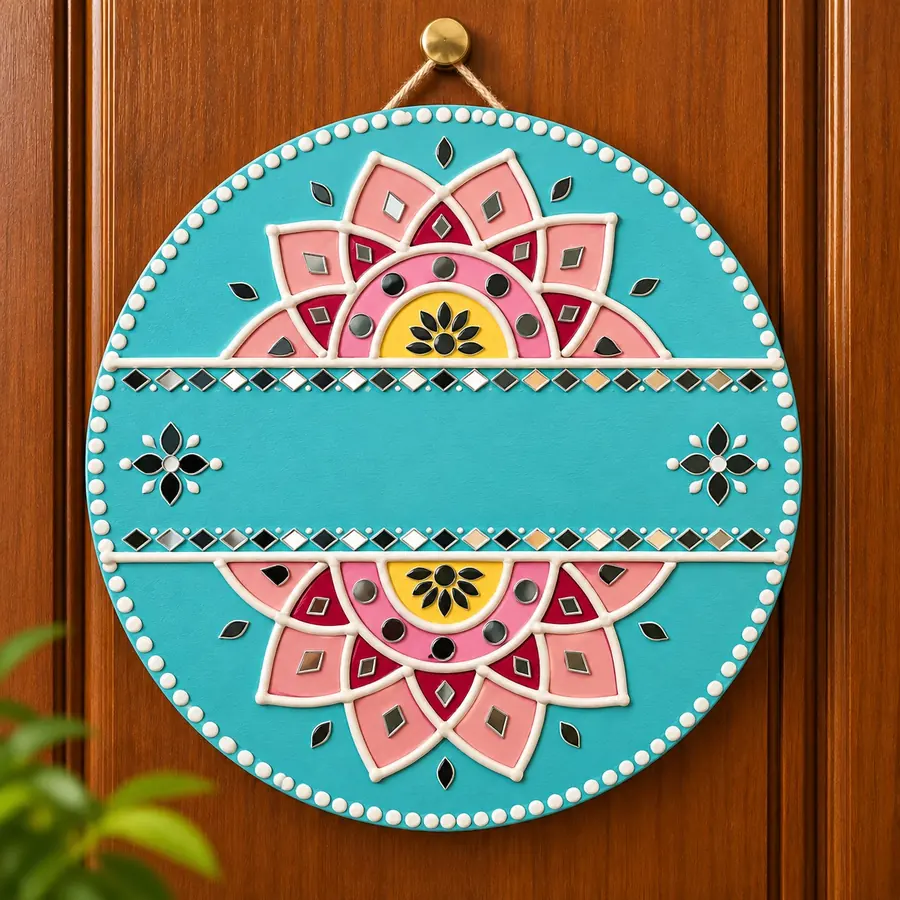
Lippan — raised clay relief with inset mirrors, from Kutch in Gujarat. The most requested, and the most adaptable to a specific wall.
Pichwai — devotional Nathdwara panels, strictly symmetrical, built around lotuses, cows, peacocks and decorated elephants.
Madhubani — Mithila work with its own language of symbols, where the motif can be chosen deliberately for an occasion.
Jharokha — hand-painted haveli window frames with jaali lattice work, which group well on a tall or empty wall.
Alongside those: custom name plates, tea light holders and candle sets. That is 4 regional traditions plus 3 made-to-order ranges, all from one pair of hands.
If you want something that mixes traditions, ask. It is often possible and it is usually the more interesting conversation.
Commissions that work especially well
A piece sized for an awkward wall that nothing off-the-shelf fits — a narrow run beside a staircase, a long low space above a sideboard.
A gift where the motif is chosen for the occasion rather than for decoration, which is where Madhubani's symbolism earns its place.
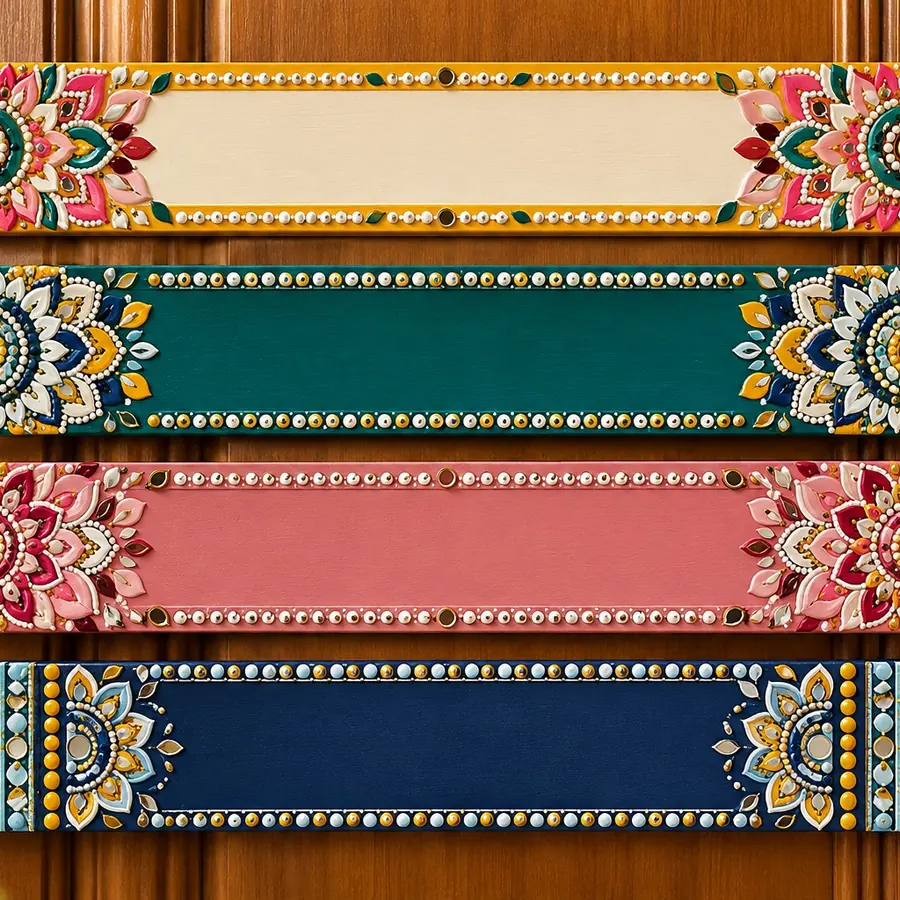
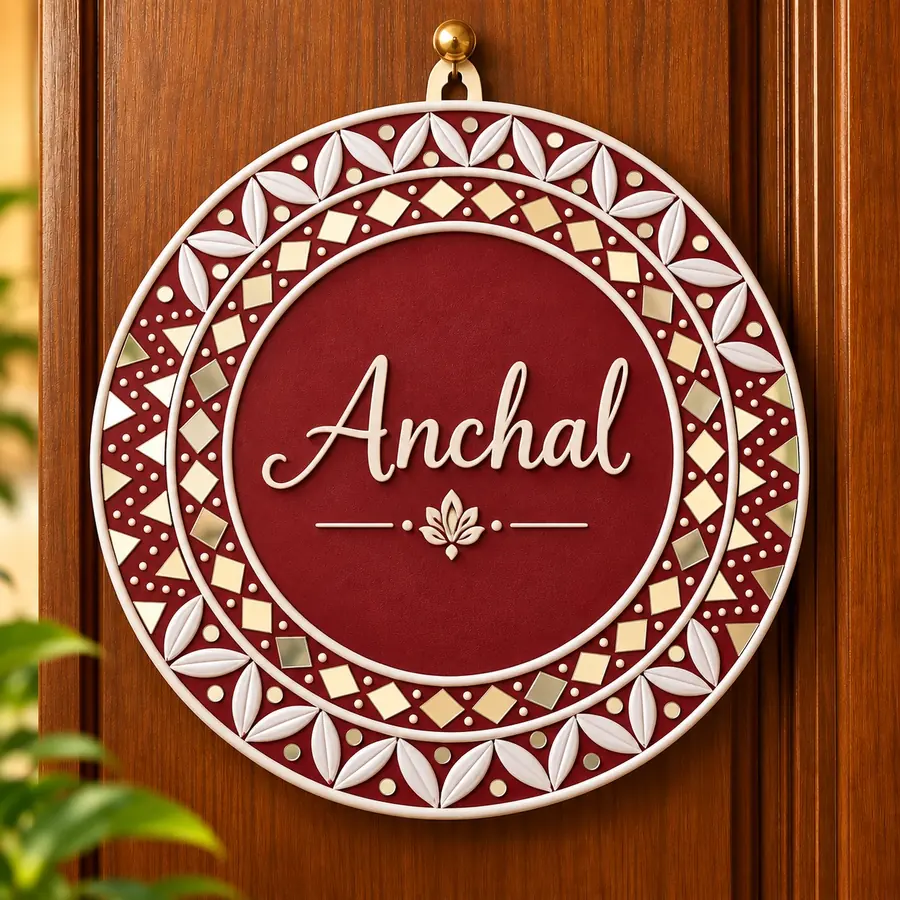
A name plate for a new home, which is the most personal thing here and the one that gets seen most often.
A matched pair or set, where the pieces are designed together rather than assembled from separate items.
Replacing or complementing something a client already owns and loves, working to its palette.
What I will not do
I will not take an order I cannot finish properly in the time you need. If the date is not realistic I will tell you at the start rather than rush the drying and send you a piece that cracks in a year.
I will not make a piece for a place it should not go. If it is destined for a bathroom, an open balcony or a wall in full sun, I will say so before you order rather than after.
I will not copy another artisan's work line for line. Send me a reference by all means — I will make my own piece in your size and colours, informed by it, not a duplicate of it.
I do not keep stock, so I cannot send you something tomorrow. If you need something immediately, I am the wrong person and I will tell you so rather than waste your week.
Packing, shipping and arrival
Relief work with mirrors is fragile, and it is packed to survive transit rather than to look good on a shelf.
Pieces ship from the Gurugram studio to the USA, the UK, Canada, Australia, the UAE and across Europe, as well as anywhere in India. Shipping cost and timeline depend on the size of the piece and the destination, and are confirmed per order before payment. No shipping rates are published here because a rate that does not account for the piece is a guess.
Customs duty and import VAT are the destination country's to set, and both the USA and the EU changed their rules during 2025 and 2026. Tell me where you are and I will tell you what currently applies before you commit.
If a piece is travelling somewhere much colder or damper than it was made, let it sit indoors for a day before hanging.
If anything arrives damaged, photograph it before unpacking any further and send me the photos straight away.
After it arrives
Unpack it carefully and keep the packaging until you are sure the piece is sound. If there is a problem, the packaging is part of the evidence.
Let it sit indoors for a day before hanging if it has travelled somewhere much colder or damper than it was made.
Hang it with a fixing rated well above the actual weight, into masonry or a stud where possible, and spread the load across two fixings rather than one so it cannot rotate out of level over time.
Keep it out of bathrooms, off walls behind a hob, and away from anywhere exposed to rain. Clay and steady moisture do not coexist.
If a mirror lifts at any point, keep it and send me a photo. It can usually be reset, and that is a repair rather than a replacement.
A short glossary
Lippan, or lippan kaam — the mud-and-mirror relief craft of Kutch in Gujarat.
Abhla — the small mirrors set into the clay relief.
Pichwai — literally behind (pichh) and hanging (wai); devotional panels from Nathdwara in Rajasthan.
Madhubani, or Mithila painting — the symbolic painting tradition of the Mithila region of Bihar.
Jharokha — the overhanging enclosed balcony window of Rajasthani and Gujarati havelis.
Jaali — the pierced lattice screen within a jharokha.
Made to order — nothing exists until it is asked for; there is no stock to ship from.
Questions before ordering
How do I commission a custom piece?
Do I pay before I see a design?
How do I pay for a commission from abroad?
Can I see the piece while it is being made?
How long does a commission take?
What makes a good brief?
Can you work from a reference image I have found?
Can I change my mind after approving the design?
What does a commission cost?
Do you take commissions from the USA, the UK, Europe or the Gulf?
Does the price include delivery?
What does a commission cost in dollars, euros or pounds?
Who pays customs duty on an international commission?
More from this collection