Madhubani art
Madhubani art, made by hand in Gurugram
Madhubani — also called Mithila painting — comes from the Mithila region of Bihar, where it was painted on the walls and floors of homes for weddings and festivals. I make Madhubani panels to order, working the motifs in raised relief with mirror detailing so they carry the same depth as my Lippan work.
Made to order in Sector 67, Gurugram · from ₹700 · shipped across India & worldwide
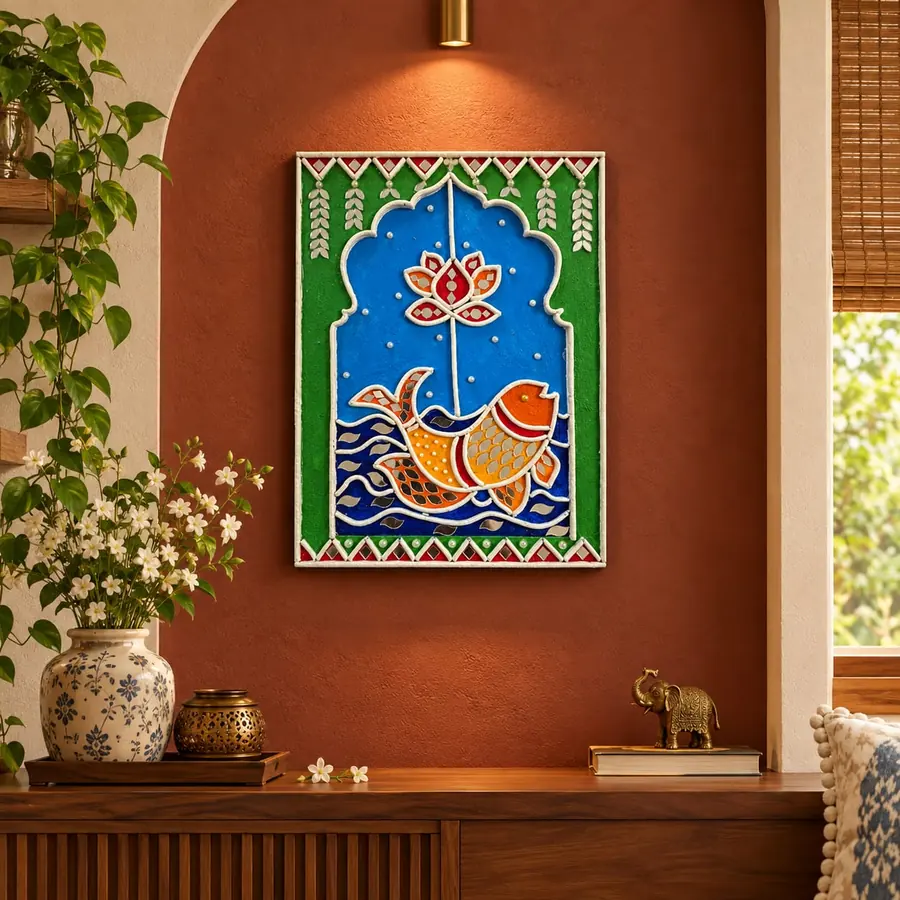
The motifs mean something
Madhubani is a language of symbols more than a style. Fish stand for fertility and good fortune. The lotus is purity. Peacocks, elephants, the sun and moon, and the kohbar — the marriage chamber design — all carry meaning that predates anyone painting them for a wall in a city flat.
That matters when you are choosing a piece for a particular occasion. A fish-and-lotus panel for a wedding gift is not the same message as a peacock for a living room, and it is worth picking on purpose rather than by colour alone.
Traditional painting, worked in relief
Classical Mithila work is flat: natural pigments and a fine brush or twig on paper, cloth or a plastered wall, with the surface filled in completely because empty space is traditionally left unused.
What I make keeps the drawing and the symbolism but raises it. Outlines are built up in relief so the motif stands off the surface, and mirrors are set into the pattern. It gives the panel physical depth and makes it read from across a room rather than only up close.
Why every inch gets filled
A finished Madhubani painting has no empty space anywhere in it. Once the main figures are drawn, every remaining gap is filled with flowers, leaves, birds, fish, geometric fill or fine hatching, until there is no untouched surface left.
This is a convention rather than a decorative habit, and it is old. The paintings were made on the walls of homes for weddings and for festivals, as auspicious objects rather than as pictures, and an unfilled space in that context reads as incomplete work.
It has a practical effect too. A densely filled surface holds together at a distance in a way an open composition does not, and these were seen across a room, in low light, on a mud wall.
For a panel on a modern wall the consequence is worth knowing before you order. Madhubani is busy. It does not do quiet. If you want something restrained for a minimal room, a Lippan piece with open clay around a single motif will serve you better, and I will say so rather than sell you a panel that fights the room it goes into.
Where it is extraordinary is on a wall that needs to carry on its own, with nothing else near it. The density that overwhelms a small space is exactly what holds a large empty one.
The double line
Look closely at any outline and there are two lines, not one. The figure is drawn with a pair of parallel contours and the channel between them is filled, usually with fine cross-hatching, sometimes with solid colour.
That double contour is the most reliable way to tell real Mithila work from something imitating it. A printed or machine-made panel almost always collapses it into a single heavy outline, because the double line is slow and there is no way to fake the slight irregularity of two hand-drawn curves running parallel.
The hatching inside the channel is where individual painters are most recognisable. Spacing, angle and whether the strokes cross or run one way are all habits, and they are consistent within one hand and different between two.
Working this in relief changes it. The two contours become raised ridges with a valley between them, and the hatching sits in that valley, so the whole outline catches light along its length instead of reading flat. It is the main reason I make these in relief rather than painting them.
Women, walls and the move to paper
For most of its history this was women's work, done on walls, and not sold to anyone. Mothers taught daughters, the paintings went up on the inner walls of a house for a wedding or a festival, and when the wall was replastered the painting went with it. Nothing was meant to last and almost nothing from before the twentieth century survives.
It came to outside attention after the 1934 Bihar earthquake, when a British colonial officer, William Archer, saw the interiors of collapsed houses in Mithila and photographed the paintings inside them.
The shift to paper came much later, during a severe drought in the region in the 1960s, when the All India Handicrafts Board encouraged the women painting on walls to paint on paper instead so the work could be sold. That is the point at which a domestic ritual practice became a sellable art form, and it is why a tradition that is centuries old has a market history of only a few decades.
It also explains why so many of the best known Mithila painters are women, and why the subject matter stayed what it was. The paintings sold on paper kept the wedding imagery, the deities and the symbol language, because that is what the painters knew and had always painted.
Choosing a panel
Tell me the occasion, the wall and the colours in the room. Madhubani uses strong colour — the reds, greens, blues and yellows are part of the tradition, not a choice I would talk you out of — but which dominates is up to you.
Panels can be made as a single framed piece or as a pair. As with everything here, you approve the design before I start.