First purchase
Buying your first Lippan piece
People buying their first piece tend to ask about design and price, and then get caught by something else entirely: the wall gets too little light, the piece arrives smaller than it looked on a screen, or the date they needed it for was never achievable. This is the conversation I wish happened before the first message rather than during it.
Made to order in Sector 67, Gurugram · from ₹700 · shipped across India & worldwide
Start smaller than you want to
The instinct on a first order is to go big, because a large piece is what you have been looking at online.
I would push the other way. A first piece is also how you find out whether you like living with relief work, how it behaves in your light, and whether the colours you chose on a screen look the same on your wall.
Something around 30 to 45cm costs less, arrives faster, and tells you all of that. If it works, the second piece can be the large one, and you will choose it far better.
The people who come back for a second piece almost always order bigger. The people who started big sometimes wish they had not.
Decide where it goes before you decide what it is
Pick the wall first. Measure the clear space, not the whole wall, and note what furniture sits under it.
Then look at that wall at three different times of day. Morning, afternoon, after dark with the lights on. Mirror work behaves differently in each, and a wall that looks fine at 6pm can be dead at 11am.
If the wall never gets light from an angle, either plan a lamp or choose painted work with strong colour instead. There is no point paying for mirrors that have nothing to catch.
What actually drives the price
Detailing, more than size. A small densely worked mandala can take longer than a larger plain panel, because every raised line is laid by hand and every mirror is set on its own.
Framing, which adds cost and has to be decided before the piece is built rather than after.
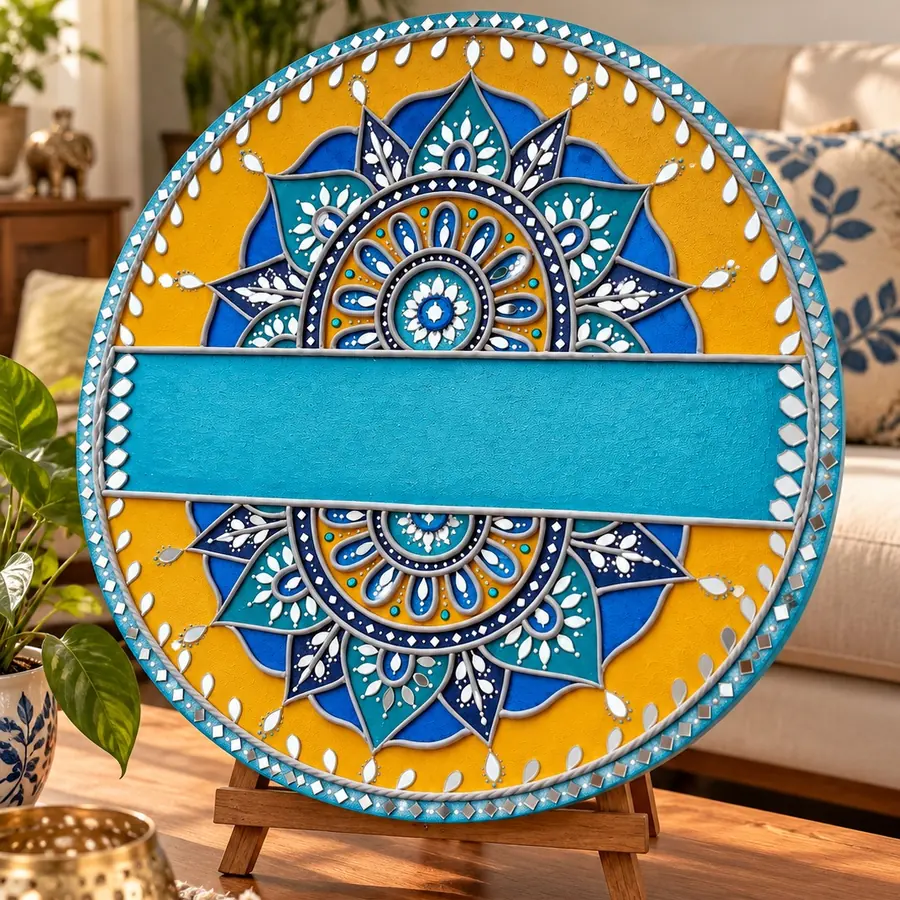
Within India pieces start at ₹700. That is a floor, not a typical price, and a first-time buyer asking what a piece like the one in the photograph costs is better off sending the photograph.
What does not drive the price much: the colours. Choosing teal over green changes nothing.
Questions worth asking any maker
How long will mine take, and what sets that? If the answer is not about drying, be curious about why not.
Are the mirrors set into the clay or glued on? Set is the traditional method and it looks different up close.
What is it built on? Most portable pieces are on board; ask which.
What happens if a mirror lifts in two years? A maker who repairs their own work will say so immediately.
Will mine be identical to the photograph? The honest answer is no, and anyone who says yes is either using a mould or has not thought about it.
What to send when you enquire
A photograph of the wall, taken straight on, in daylight. This single thing shortens the conversation more than anything else.
The measurement of the clear space.
Two colours from the room. Not a mood, two actual colours, ideally from the largest soft furnishing and from the wood or metal in the space.
The date you need it by, if there is one. At the start, not the end.
That is five minutes of work and it usually removes two or three rounds of back and forth.
What arrives, and what to do with it
It will be heavier than you expect. Clay and mirrors on board are not a canvas.
Let it sit indoors for a day if it has come from a very different climate, before you hang it.
Fix into masonry or a stud, use two fixings spread across the width rather than one in the middle, and use something rated well above the actual weight.
Keep the packaging for a week, until you are sure it travelled well.
Five mistakes on a first order
Buying for the photograph, not the wall
The piece in the photograph was made for someone else's room and lit for a photograph.
Choosing colour on a screen
Screens are backlit and your wall is not. Work from a photograph of your room instead.
Leaving the date until last
Drying sets the timeline and it cannot compress. A date mentioned in the fourth message is sometimes a date that was never possible.
Putting it somewhere damp
Bathrooms and the wall behind a hob. This is the one mistake that cannot be undone.
Expecting a catalogue
There is no stock. Nothing exists until it is asked for, which is slower and is the reason it fits your wall.
When Lippan is the wrong choice
If you need something this week. Nothing here is held in stock.
If the only free wall is in a bathroom, a kitchen behind the hob, or anywhere exposed to weather.
If you want something exactly identical to an image you have seen. Hand work varies, and that variation is the product.
If you move house every few months and do not want to think about fixings each time. Tea light holders and tabletop pieces suit that better.
I would rather say this now than take an order that disappoints you.