Rented homes
Decorating a rented wall you cannot drill
A Lippan piece 45cm across is heavier than it looks. Clay, board, mirrors and paint add up, and the weight sits across the whole panel rather than on a frame. That single fact decides almost everything about hanging one in a flat where you are not allowed to make holes, and it is why most of the advice written for posters and canvases does not transfer.
Made to order in Sector 67, Gurugram · from ₹700 · shipped across India & worldwide
Read the agreement before you read anything else
Most Indian rental agreements say nothing specific about nails. Some ban them outright. Many say the flat must be returned in its original condition, which is vague enough to go either way and usually gets resolved in the landlord's favour at the end.
If it is ambiguous, ask in writing and keep the reply. A message saying two hooks are fine is worth more than an argument about a security deposit eleven months later.
Plenty of landlords say yes, particularly if you offer to fill and touch up when you leave.
Why weight is the whole problem
A printed canvas of the same size might be half a kilo. Clay relief with mirrors on an MDF board is several times that, and the load is distributed rather than concentrated.
Adhesive strips are rated for a weight, and the rating assumes a flat back, a clean dry wall, and a vertical pull. A relief panel often fails at least one of those.
The failure mode matters too. A poster that falls off is annoying. A clay piece that falls breaks, and mirror fragments go further than you would expect.
What adhesive strips actually hold
On a smooth painted wall in a dry room, good strips will hold a light framed piece. I have had customers hang small name plates this way without trouble.
They fail on textured paint, on distemper, on walls that have been painted over many times, and in any room that gets humid. Indian summers do not help.
If you are going to try, use more strips than the weight suggests, clean the wall with alcohol first, and press for far longer than the packet says. Then hang the piece low enough that a fall would not be a disaster.
I would not use them for anything over about 30cm.
Look at what is already in the wall
Most rented flats already have holes. Old hooks, a nail where a previous tenant hung a calendar, a picture rail in older buildings.
Using an existing hole is not making a new one. This is the simplest answer and most people overlook it because the hole is in a slightly inconvenient place and they would rather have the piece centred.
Curtain rods, door frames and false ceiling channels can sometimes take a hanging piece on a cord. Worth looking at before you rule out hanging altogether.
Lean it instead
This is what I suggest most often and it is the option people resist, because it does not feel like decorating.
A piece leaning on a console, a shelf, a mantel or the back of a sideboard looks deliberate rather than makeshift, and it solves the whole problem. Lean it against the wall at a slight angle, put something with weight in front of one corner, and it will not slide.
It also means you can move it. In a flat you will leave in a year or two, that is worth something.
A framed piece leans better than an unframed one. The frame gives it a foot to stand on.
Pieces that were never meant for a wall
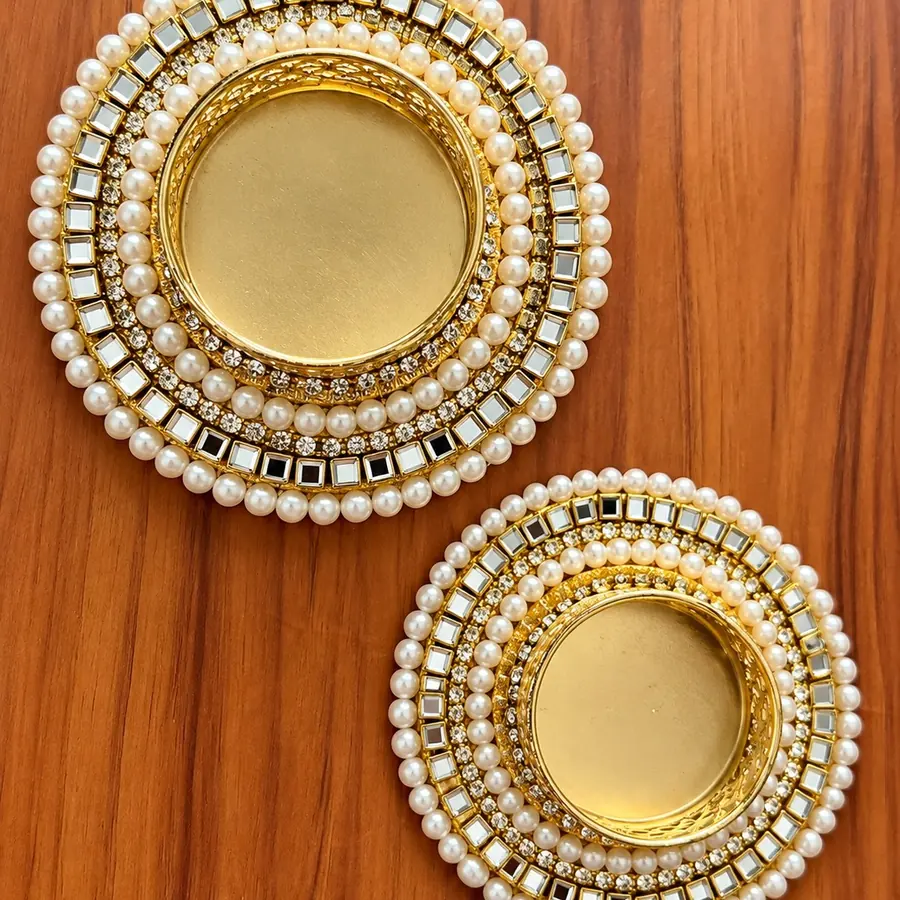
Tea light holders and candle plates sit on a table and need no permission from anybody. They carry the same craft, the same mirrors, the same hand work.
For a rented flat this is often the better buy. You get the thing you actually wanted, which is the light moving across mirror work in the evening, without a conversation with your landlord.
They are also the easiest things here to pack and move.
Command strips, honestly, by weight
The manufacturers publish holding weights and those numbers assume ideal conditions. Treat them as a ceiling you should stay well under, not a target.
My own rule is to halve the stated rating, then pick a piece under that. If a strip set claims two kilos, I would not hang more than one kilo from it.
Clean the wall with rubbing alcohol first, not water, and press for thirty seconds per strip. Then leave it an hour before hanging anything.
Humidity is what kills them. In a Delhi July, a strip that held fine in February can let go.
Walls that will not take anything
Some rented flats have walls that defeat every option. Loose distemper, hollow partition board, tiles.
On distemper, nothing adhesive will hold, because the surface itself comes away.
In that case stop trying. A piece on a shelf, a console or the floor leaning against the wall gives you the same thing visually and costs you nothing in deposit.
Choosing smaller, on purpose
If you are set on a wall piece, go smaller than you would in a flat you owned. Under 30cm, framed, and the hanging problem shrinks with it.
A group of three small framed pieces can fill as much wall as one large panel and each one weighs a fraction as much.
Tell me it is for a rental when you order. It changes what I would make, and I would rather design to the constraint than have you fight it afterwards.
Leaving cleanly
If you did use a hook, take it out, fill the hole with a bit of wall putty, let it dry, sand it flat with your finger and touch in the paint. Fifteen minutes and the hole is gone.
Keep a note of the paint shade when you move in. Easier than matching it in a hurry on your last weekend.
Pull adhesive strips slowly and downward, along the wall rather than away from it. Pulling outward is what takes the paint with it.
What landlords actually object to
In my experience it is rarely the hole itself. It is a wall left with four holes and no explanation, found on the day the flat is handed back.
Ask first, offer to make good, and most of the time the answer is yes. Ask afterwards and you are negotiating from a worse position.
Societies with strict rules usually apply them to the common areas and the external door face rather than the inside of your flat. The corridor is where you will get pushback, not the living room.
Moving out, and taking it with you
Pieces made here are built on board, which means they travel. That was a modern adaptation of a craft that originally went straight onto a mud wall and stayed there.
Wrap it face to face with another flat object if you have one, or face to a sheet of cardboard, and carry it upright. Never flat in the bottom of a box with things on top.
The commonest damage I see is from a house move, not from a fall off a wall. People pack carefully for the glassware and throw the art in last.
If a mirror lifts during a move, keep it. It can be reset.
What I would do in a rented flat
Tea lights and a candle plate on the table. One small framed piece leaning on the console. Nothing drilled.
If the landlord says yes to hooks, then one properly hung piece on the wall that gets the best light, sized to the furniture under it.
That combination costs less than one large panel and you can take all of it with you.
Questions before ordering
Can Lippan art be hung without drilling?
How heavy is a typical piece?
Will adhesive strips hold a mirror work piece?
What is the safest option for a rented flat?
Can you make a lighter piece for a rental?
Can a piece stand rather than hang?
How do I remove a hook without damaging the wall?
Do tea light holders work as wall decor?
More from this collection