Placement
Where to hang art, according to Vastu
I get asked about Vastu more than any other question that is not about price, usually in the form of "which wall should this go on". What follows is what the tradition says, set out plainly. I am an artisan and not a Vastu consultant, so I am reporting the convention rather than vouching for the outcome. Where the tradition and the practical reality of a room pull in different directions, I say so.
Made to order in Sector 67, Gurugram · from ₹700 · shipped across India & worldwide
What this page is and is not
Vastu shastra is a body of convention about how buildings and the things in them are arranged. It has rules about direction, and those rules extend to what hangs on a wall.
I am setting out the convention. Whether following it changes anything in your life is a question I have no way to answer and will not pretend to.
What I can say is that a lot of my customers care about it, that the rules are easy to follow, and that in most rooms they cost you nothing to respect. Where they would cost you something, I will tell you.
Find your directions before you choose anything
Stand in the middle of the room with a compass, or the compass app on your phone, and face the wall you are thinking about. That is the direction the wall faces.
Do this once for the whole house rather than guessing room by room. People routinely get it wrong by ninety degrees and then follow the rules for the wrong wall, which is worse than ignoring them.
Write it down. You will need it again when you hang something else.
The north wall
North is associated with wealth and with flow. Water imagery belongs here in the convention, which is why you see so many waterfall paintings sold for north walls.
Greens and blues suit the direction. Heavy dark reds generally do not.
Mirror work sits comfortably here. The association with light and movement does not conflict with anything the tradition says about north.
The east wall
East is about beginnings, health, and the rising sun. Sunrise scenes, birds, and green landscapes are the conventional subjects.
In practice the east wall is also where the morning light lands, which makes it the strongest wall in most rooms for anything with relief or mirrors. The tradition and the physics agree here, which is not always the case.
If you only have the budget or the wall space for one piece, this is usually where I would put it.
South and west
South carries fire and strength in the convention. Reds, oranges and earth tones belong here. The seven horses painting, which you will have seen in a hundred Indian living rooms, is conventionally a south wall piece.
West is associated with stability. Heavier, more grounded subjects.
Both walls take strong colour better than north and east do, which is useful, because a south or west wall in a north Indian flat often gets harsh afternoon light that washes out anything pale.
The northeast and the pooja corner
Northeast is the most particular corner in Vastu. It is where the convention places the pooja space, and it asks for restraint rather than display.
Keep the scale modest here. This is not the wall for a statement piece, and a large heavily coloured panel in a northeast corner works against everything the convention is trying to do.
Light, symmetrical, quiet. A small mandala or a modest Pichwai panel suits it.
Subjects the convention avoids
Images of suffering, decay, violence, or isolation are discouraged throughout. So are single lone figures and scenes of sinking or falling.
Thorny plants and dead trees, conventionally, stay out. Cacti get mentioned specifically.
This is the part of Vastu I find easiest to agree with regardless of belief. Almost nobody wants a sad picture in their living room.
Where mandala and geometric work fit
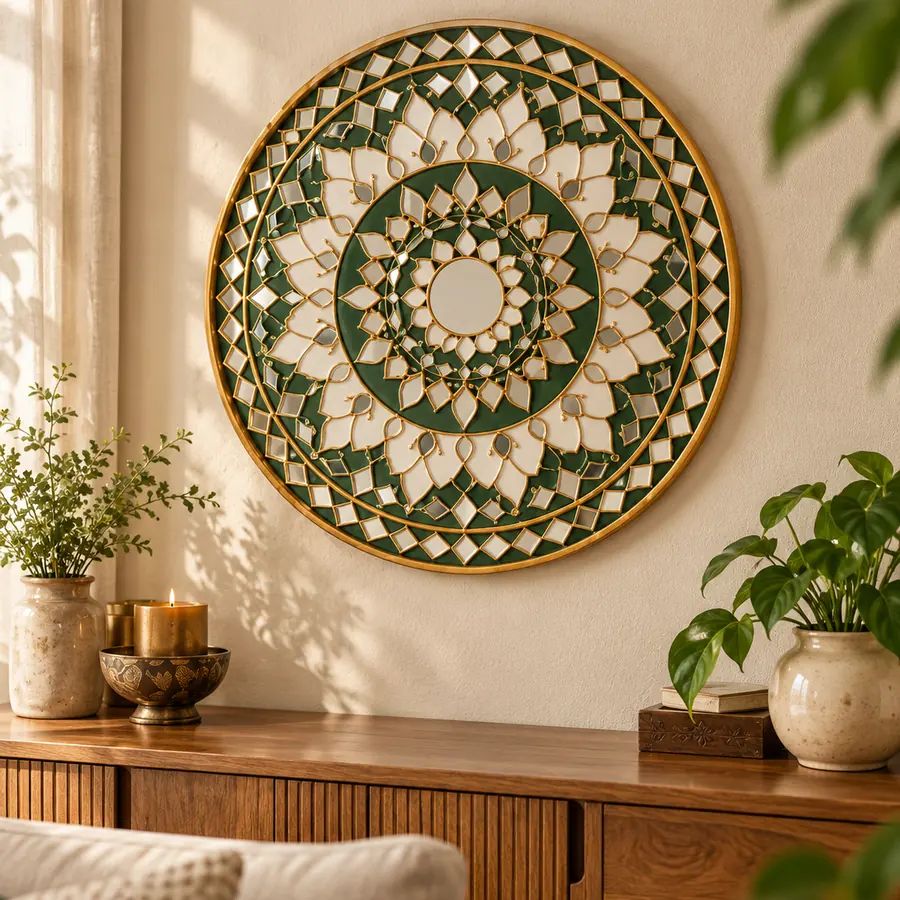
Symmetrical geometric forms are treated gently by the convention. A mandala is balanced across both axes, which means it does not push energy in any one direction, and that makes it unusually flexible about where it hangs.
If you want one piece that is defensible on almost any wall, a mandala is it.
That flexibility is also why I make more mandalas than anything else, though the reasons people give me vary.
Where Vastu and the room disagree
Here is the honest part. The tradition says nothing about light, and light is what makes or breaks mirror work.
If the convention points you at a wall that never sees daylight and has no lamp near it, you will have a piece that does nothing for most of the day. The mirrors need something to catch.
The tradition also says nothing about scale. A correctly placed piece that is half the size the wall needs still looks wrong.
My own view, for what it is worth: get the direction right if you can, but do not take a wall with no light over a wall with light. A piece you cannot see properly is not serving anybody.
The entrance
The main door and the wall beside it get more attention in Vastu than almost anywhere else, because it is where the convention says everything enters.
Keep it welcoming and keep it uncluttered. A name plate, something above or beside the door, and nothing fighting for attention.
Ganesha at the entrance is the most common request I get, and it is conventional for exactly this reason.
The bedroom, treated differently
Bedrooms get their own rules and most of them are about calm. Water imagery is discouraged here even though it is encouraged on a north wall elsewhere, which catches people out.
Mirrors facing the bed are discouraged. Mirror work in a frame on a side wall is a different thing from a mirror you can see yourself in, but if this matters to you, say so and I will keep the mirror density low.
Pairs rather than single figures, if the room is shared.
If you do not follow Vastu at all
Plenty of people do not, and the rules that still hold are the ones that were never really about direction.
Light raking across a piece rather than hitting it flat. Scale that matches the wall and the furniture under it. Keeping clay away from steam and damp. Two fixings rather than one so it cannot rotate out of level.
Those four will do more for how a piece looks than any compass reading.
Rented flats and shared walls
Vastu assumes you can choose. In a rented flat you often cannot, and the compass reading is academic if there is one free wall and a landlord who does not want holes in it.
The usual compromise is to apply the convention to the things you can move rather than the things you cannot. A piece on a console or a shelf can be positioned by direction even if the wall it sits against was never a choice.
In a shared flat the entrance is usually the only space everyone agrees on, which makes it the one place the convention is worth applying properly.
Common mistakes with this
Reading the compass from inside a doorway rather than the middle of the room. The reading shifts and people end up following rules for the wrong wall.
Treating every room as a separate puzzle. The directions are fixed for the whole house. Work them out once.
Buying for the direction and ignoring the furniture. A correctly oriented piece hung 40cm too high because that is where the hook already was still looks wrong.
Assuming more pieces means more benefit. The convention is about placement, and a crowded wall is not improved by any of it.
Choosing the piece once the wall is settled
Tell me the direction when you message me, along with the measurements and the light. It changes what I would suggest, and it is quicker than going back and forth about colour.
Within India pieces start at ₹700. Orders going abroad start at ₹3,500, with delivery quoted on top.
If the direction you want is one the convention treats carefully, say so at the start and I will design to it rather than trying to retrofit it afterwards.
Questions before ordering
Which direction should paintings face as per Vastu?
Can Lippan art go on any wall as per Vastu?
What should not be hung in a bedroom?
Is mirror work allowed as per Vastu?
Which wall is right for a pooja room?
Does direction matter more than the subject?
Can I commission a piece for a specific direction?
What if the only free wall faces the wrong way?
Is a mandala suitable for any direction?
More from this collection