How it is made
What sustainable means for handmade decor
The word has been used to sell so much that it has stopped carrying information. I would rather tell you what is specifically true about how things are made here, let you decide what that is worth, and be clear about the parts where I have nothing to offer. Some of this is genuinely better than the alternative. Some of it is a trade, not a win.
Made to order in Sector 67, Gurugram · from ₹700 · shipped across India & worldwide
Nothing is made until somebody asks for it
There is no catalogue here because there is no stock. Every piece exists because a specific person wanted it for a specific wall.
That is the single biggest difference between this and almost everything else you could buy. A shop has to guess what will sell, make that, and then discount or dispose of what it guessed wrong about.
I have never had to discount anything, because I have never made anything speculatively.
No stock means no deadstock
The home decor industry produces an enormous amount of product that is never sold. It ends in clearance, then in liquidation, then in landfill.
I cannot give you a figure for that and I am not going to quote one I have not verified. What I can tell you is my own number, which is zero, because the question does not arise.
This is less a virtue than a consequence of being one person. A larger studio could not work this way.
What the pieces are made of
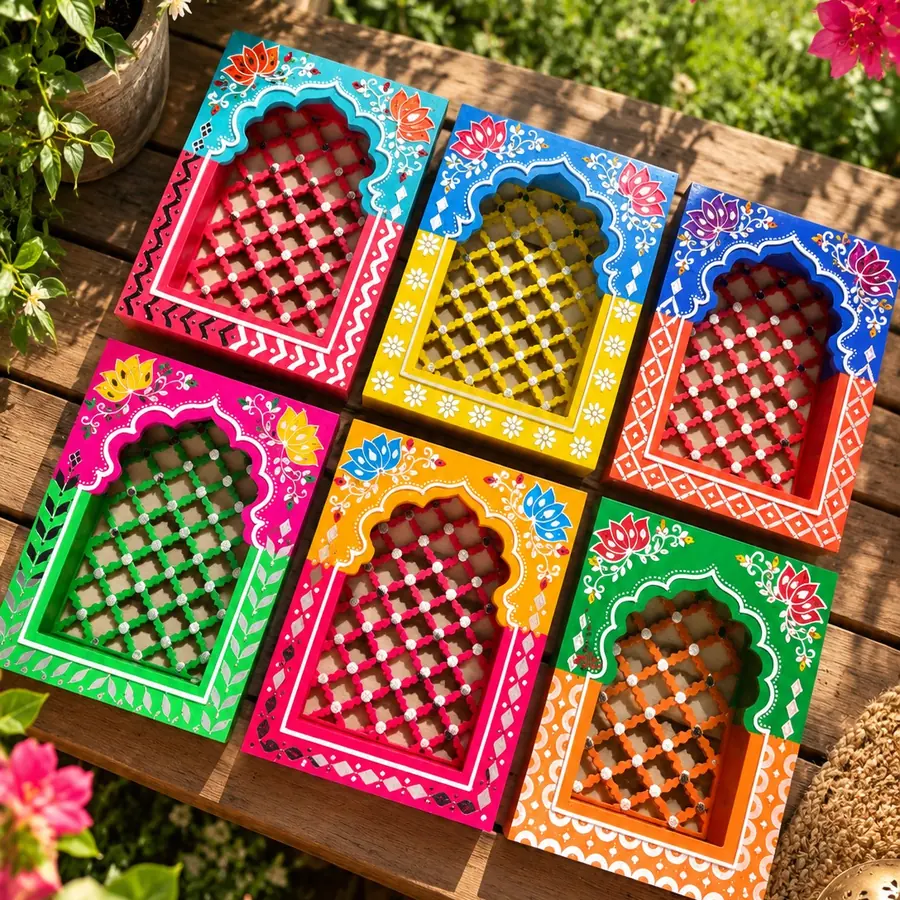
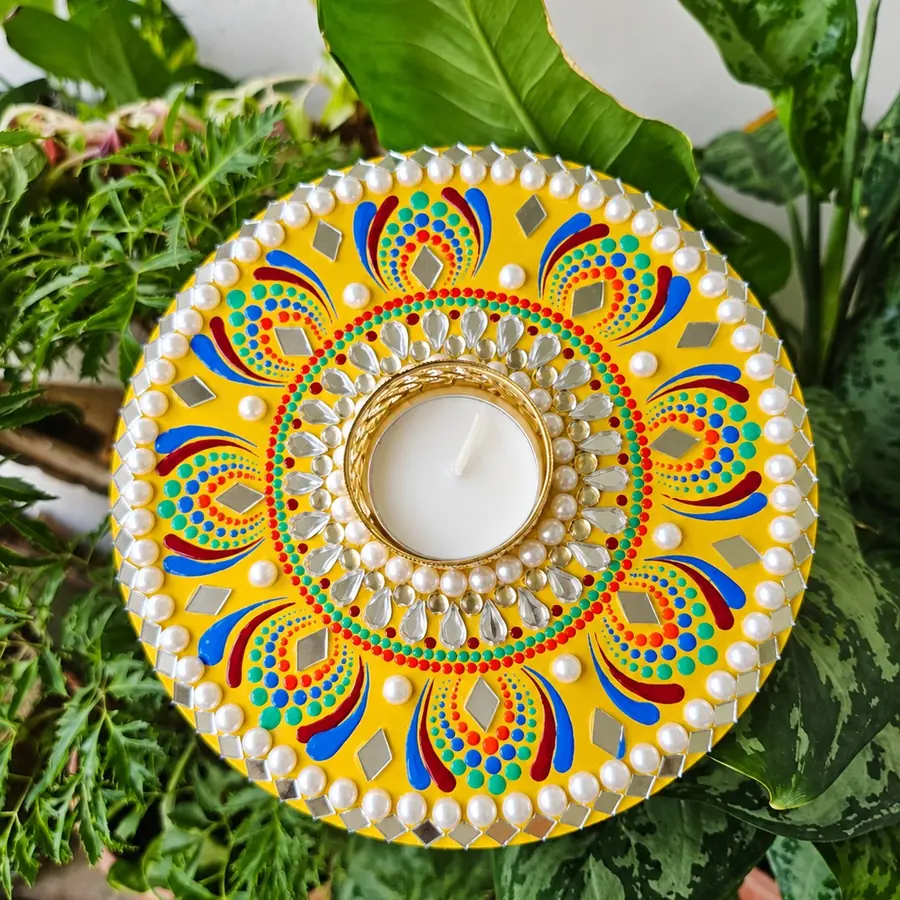
Clay, worked by hand into raised relief. Small mirrors, called abhla. Paint. A board, usually MDF, as the base for anything portable.
Traditionally this work went straight onto a mud wall and there was no board at all. The board exists so a piece can be moved, hung, and shipped, which is a modern requirement rather than a traditional one.
MDF is the honest weak point in that list. It is an engineered wood product and it is not the most sustainable substrate available. It is what makes a piece survive transit, and I have not found a better compromise.
Built to outlast the room it goes in
Indoors and away from moisture, these last indefinitely. The tradition survived on the interior walls of Kutch houses for generations, which is a reasonable test.
That matters more than the materials do. A piece bought once and kept for thirty years has a different footprint from four trend-led pieces bought and replaced across the same period.
It is also why I push back when somebody asks for something very of-the-moment in colour. A palette that dates in three years undoes the main advantage of the thing being durable.
A lifted mirror is a repair
If a mirror comes loose, it can almost always be reset. Send me a photograph and keep the mirror.
Hairline cracks can often be filled and repainted in a way that does not show. Structural damage to the relief is harder and sometimes the honest answer is that replacement is better.
The point is that repair is a normal outcome here rather than an exception. Mass-produced decor is usually not repairable at any sensible cost, and that is a design decision somebody made, not a law of nature.
One pair of hands, and what that limits
Everything is made by one person. That means no factory, no production line, and no supply chain beyond the materials.
It also means I cannot take a thousand-unit order, I cannot ship tomorrow, and there are weeks in festival season when I will tell you a date is not possible.
If you want the environmental argument to hold, you have to accept the slowness. They are the same fact described twice.
Packaging, and the part I find hardest
Clay relief set with mirrors is fragile. Packing it to survive a courier means more material than I would use if I only had to make it look nice.
I pack to protect rather than to present, which means the box is not beautiful and there is more in it than you might expect. A piece that arrives broken has a far worse footprint than one that arrives in too much padding.
This is a trade I make deliberately and I am not going to pretend it is costless.
Shipping, honestly
A piece sent from Gurugram to Berlin has travelled a long way, and no amount of careful making changes that.
If you are in Delhi NCR, local delivery or studio pickup is the lower-impact option and I will say so.
If you are abroad, the honest position is that the distance is real and the piece needs to be worth the journey. A small framed panel that lasts decades probably is. Six small items shipped separately across a year probably are not. Order together if you can.
What I cannot claim
I have no certification. Not GOTS, not Fairtrade, not a carbon label, and I am not going to buy one so it can sit in a footer.
I have not measured a carbon footprint for a piece and I do not have the means to do it properly, so any number I gave you would be invented.
I cannot fully trace where the mirrors and the paint originate. They come through suppliers in India and I have not audited them.
The board is MDF. That is the least defensible material in the whole process and I have said so above rather than leaving it out.
Anybody who tells you a handmade piece has no footprint is selling you something.
The repair question, asked properly
A thing is only durable if somebody will fix it. Most decor fails that test, not because it cannot be repaired but because nobody offers to.
I will repair work I made, and I have repaired work I did not. What I cannot do is match an unknown maker's clay mix exactly, so somebody else's piece comes back more visibly mended than mine would.
If you are weighing up a handmade piece against a cheaper mass-produced one, this is the question worth asking the seller. Most of them have no answer.
What a longer life actually requires of you
Dust it with a dry brush rather than a cloth. Keep it away from steam and from a wall that gets washed. Two fixings rather than one.
None of that is difficult and all of it is the difference between a piece lasting five years and thirty.
The least sustainable thing you can do with a handmade piece is hang it in a bathroom and replace it in two years.
Comparing it with the mass-produced alternative
A printed canvas of similar size costs a fraction and arrives in two days. I am not going to pretend otherwise, and for plenty of situations it is the sensible buy.
Where the comparison shifts is over time. The print will fade, the frame will warp, and in five years it is landfill because nobody repairs a print.
If you are furnishing a rental you will leave in a year, buy the print. If this is a wall in a home you intend to stay in, the arithmetic goes the other way.
What I would like to improve
The board. MDF is the least defensible thing in the process and I have not yet found a substrate that survives transit as well at a sensible cost.
Packaging volume, which is driven by fragility and which I have reduced about as far as I dare.
Supplier traceability for the mirrors and paint, which I have not done properly and will not claim to have done.
Buying less, better
The most useful thing I can say is also the least commercial. One piece you will keep beats three you will replace.
If you are furnishing a room, buy the one wall that matters and leave the others for later. You will choose better in six months than you will under pressure now.
That advice costs me orders and I still think it is right.
Questions before ordering
Is handmade automatically more sustainable?
What are the pieces made from?
Can a damaged piece be repaired?
Do you hold stock?
Is the packaging recyclable?
Does shipping from India undo the benefit?
Do you have any sustainability certification?
Are the materials natural?
More from this collection