Entrance
Styling the entrance, not just the door
Almost everyone who writes to me about an entrance is thinking about the door. The door is the hardest surface in the house to decorate, because it moves, it gets touched constantly, and in a flat it usually is not yours to alter. The wall beside it is sitting empty and is where most of the opportunity actually is.
Made to order in Sector 67, Gurugram · from ₹700 · shipped across India & worldwide
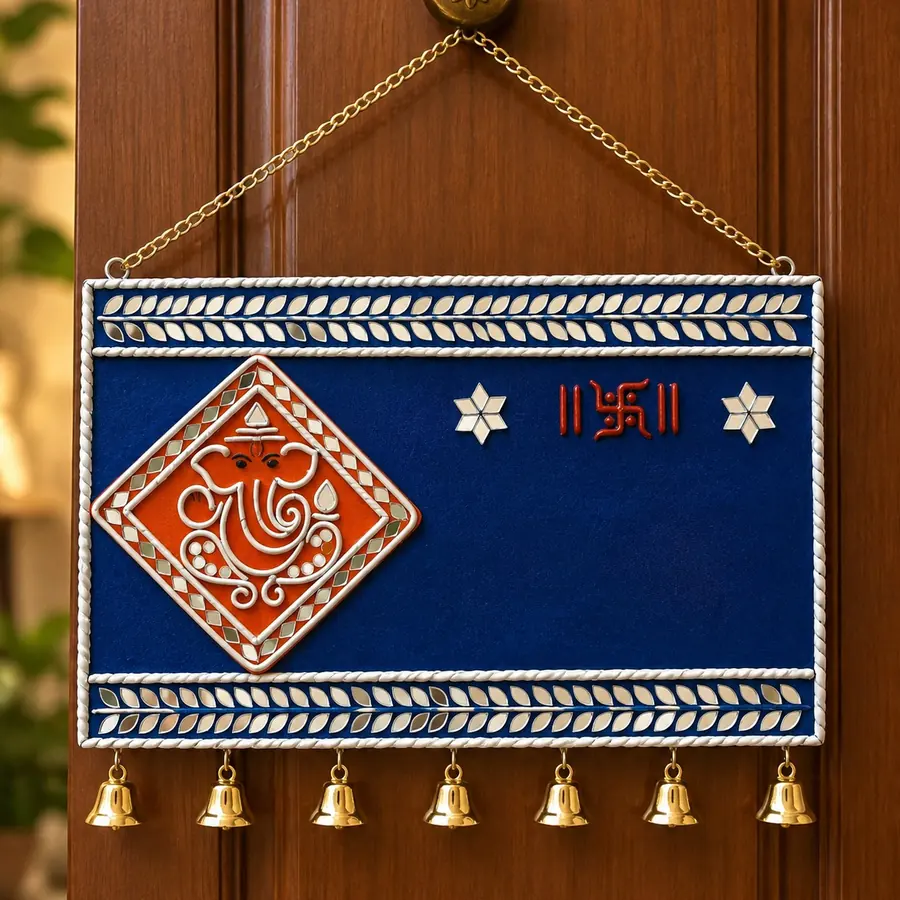
What a visitor actually sees, in order
They see the door from a distance as they approach. Then the name, because they are checking they have the right flat. Then, while they wait, whatever is on the wall at eye level beside them.
That third thing is the one almost nobody plans, and it is the one they look at longest.
Design for the waiting, not for the arriving.
The wall beside the door
In most flats there is a strip of wall between the door frame and the corner, often 40 to 70cm wide. It is usually blank.
A vertical piece suits it. A round one rarely does, because the strip is taller than it is wide and a circle leaves awkward space above and below.
If the strip is narrow, a single tall Jharokha frame works better than anything else I make. It was a window, so a vertical proportion is native to it.
Narrow lobbies and landings
In a shared landing you cannot stand back, so the piece is always seen from a metre or less. Detail is legible and scale needs to come down.
Nothing that projects far from the wall. People carry bags and furniture past it, and a piece that sticks out will eventually get caught.
Flat relief rather than anything with hanging elements, if the passage is tight. Bells look wonderful and they are the first thing to get knocked.
Light, which is usually the problem
Entrances are the worst-lit part of most Indian homes. A corridor with no window and one overhead bulb does nothing for mirror work.
If that is your situation, either add a small wall light angled across the piece, or stop trying to use mirrors there and go for painted work with strong colour instead.
Where there is a window on the landing, the piece should go on the wall it lights rather than the wall opposite the door, even if that feels less obvious.
Layering, without clutter
An entrance that works usually has three things at different heights and nothing else. Something at eye level, the name plate, and something at floor or console height.
The common mistake is adding a fourth and a fifth. A toran, a hanging, a plate, a mirror, a shoe rack and a plant is not a composition, it is an accumulation.
Pick the one thing that will be looked at and let the others support it.
Flats, societies and what you are allowed
In most apartment societies the external face of your door and the common wall beside it are not entirely yours. Some RWAs are relaxed, some are not.
Check before you commission something sized to that wall. A piece made for a space you are then asked to clear is an expensive lesson.
The inside face of the door and the wall just inside the entrance are always yours, and in a society with strict rules that is where I would put the money.
Height, and the thing people get wrong
An entrance piece wants to sit higher than a living room one, because the viewing distance is shorter and the eye line is different when you are standing rather than sitting.
Centre it around 150 to 160cm rather than the 145 I would use over a sofa. In a corridor where people pass close, higher again.
Beside a door, align the centre of the piece with something on the door itself, the handle or the top of the panel, rather than centring it in the wall strip. The eye reads the two together and an alignment it can find looks deliberate.
Shoe racks, keys and the things that actually live there
Every Indian entrance accumulates shoes, keys, umbrellas and a bag somebody meant to take back to the car.
Any piece you hang at waist height will eventually have something leaning on it. Keep the artwork above that zone and leave the lower wall to the clutter, because the clutter is not going anywhere.
A hook rail under the piece rather than beside it keeps the vertical line tidy and stops keys being hung on the frame, which people do.
Seasonal layers
Torans, marigold strings and festival hangings come and go, and the permanent piece has to still work when they are up.
Which argues for keeping the permanent piece simple. Something busy competes with a toran rather than sitting under it.
Leave a nail or hook free at the top of the frame for seasonal things rather than hanging them over the artwork.
Outside, and why most of this is interior work
Almost everything I make is for indoors. Clay relief and rain do not coexist, and a Lippan piece on an open gate will not last a monsoon.
A covered porch or an enclosed lobby is usually fine. Direct exposure is not.
Painted wooden pieces cope better than clay, and for a genuinely exposed position I would say buy something made for the weather rather than something I make.
If you tell me where it is going and it is somewhere it should not be, I will say so before you order.
Independent houses and a real front door
If the door is yours and it is under a porch, the options open up. A larger piece beside the door, a set rather than a single, something at the height a car headlight would catch in the evening.
Depth matters here in a way it does not in a corridor. A piece with real relief reads properly in raking evening light on a porch wall.
Still keep clay out of the rain. A porch roof that stops vertical rain does not stop a monsoon blowing sideways, and I have seen the result.
The floor, which nobody mentions
Indian entrances often have patterned tiles, a dark granite threshold, or a strip of a different material marking the doorway.
That floor is in the visitor's field of view at the same time as the wall, and if both are busy they fight.
Send me a photo that includes the floor. I have changed a palette more than once after seeing the tiles.
Commissioning an entrance set
A name plate and a wall piece designed together look like a pair. Bought separately they usually do not, because the palettes drift.
Send me a photo of the whole entrance including the door and the floor, plus the width of that wall strip. The floor matters more than people expect, because entrance tiles are often doing something loud.
The name plate detail, scripts, shapes and sizes is all on the name plates page. This page is about the wall around it.
Questions before ordering
What should go beside the main door?
Can a piece go outside on a gate?
What suits a narrow entrance?
Can the name plate and the wall piece match?
Does an entrance piece need light?
Am I allowed to put something on the wall outside my flat?
Can you make a full entrance set?
What about torans and festival hangings?
More from this collection