History
Where Lippan art came from
Lippan is usually sold as decoration and explained as tradition, which skips the part that makes it interesting. It was a solution to a specific problem in a specific place: how to make a windowless mud house in a desert cooler, and how to light it after dark with one oil lamp. Everything that now looks decorative started as an answer to one of those two questions.
Made to order in Sector 67, Gurugram · from ₹700 · shipped across India & worldwide
Kutch, and why the craft is shaped by it
Kutch is the western edge of Gujarat, bordering the Rann, and it is hot, dry and prone to earthquakes. The building tradition there answers all three.
There was very little timber and a great deal of clay. So houses were built from what was underfoot, and anything applied to a wall was made from the same material.
The craft did not travel to Kutch. It is a product of Kutch, and you can read the climate in it.
The bhunga
A bhunga is a round, single-roomed mud house with a conical thatched roof. The circular plan is the part that matters structurally, because a round wall has no corners to concentrate stress, which is why bhungas have survived earthquakes that flattened rectangular buildings around them.
Inside, there is one room, very few openings, and therefore very little daylight. That is deliberate. Small openings keep the heat out.
It also means the interior is dark for most of the day, and almost entirely dark after sunset. The wall decoration is a response to that.
The curved interior wall is also why the patterns are what they are. A design laid on a curve cannot rely on straight lines and right angles, and concentric, radial forms sit naturally on it.
Mud first, mirrors second
The base material is clay, traditionally mixed with other binders available locally, worked into raised lines directly on the wall by hand.
The relief does two things. It insulates slightly, which matters in a climate that swings hard between day and night. And it holds the mirrors.
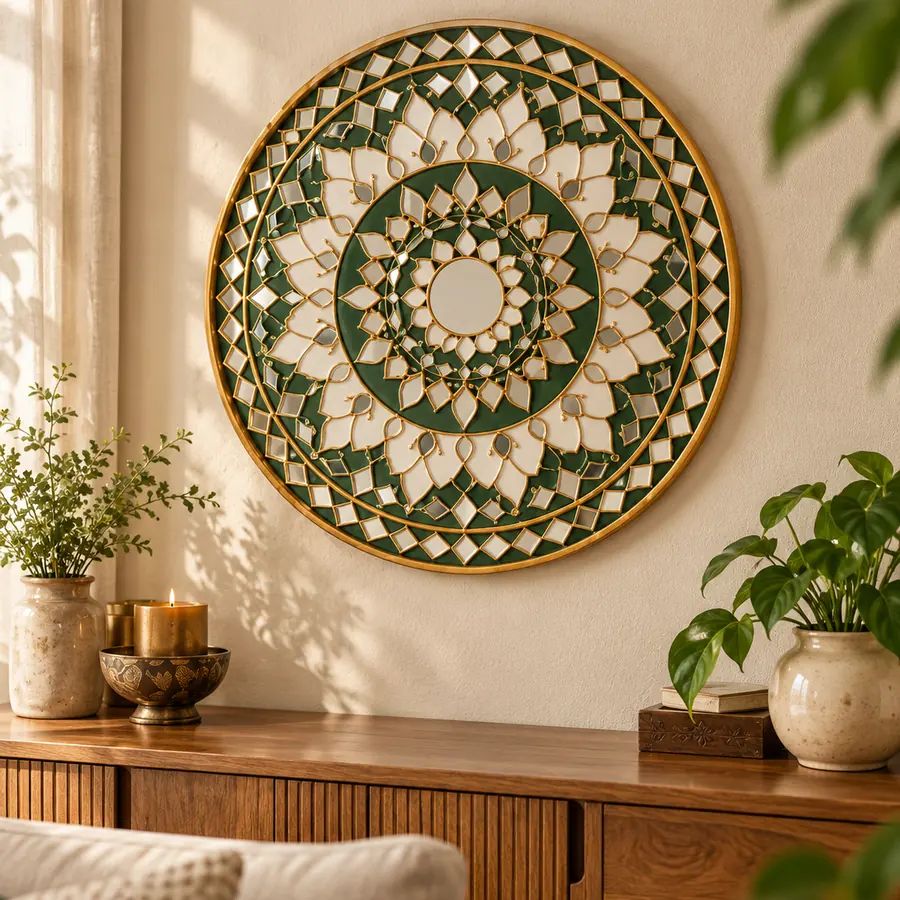
Abhla, the small mirrors, are set into the clay while it is still soft. In a room with one oil lamp, a wall of set mirrors multiplies that single light source across the whole interior. The effect is not subtle and it is not decorative in origin. It was lighting.
Who made it
This was domestic work, done by women on their own homes, and it passed down within families rather than through workshops or guilds.
Several communities of Kutch are associated with it, among them the Rabari, who are pastoralists, the Mutwa, and the Meghwal. Each has its own conventions, and a practised eye can often tell them apart by the density of the mirrors and the structure of the patterns.
Nobody signed anything. The work was not made to be sold and there was no concept of an artist's name attached to it.
That is worth knowing when you buy a piece today, because the idea of a named maker is a modern addition to this craft, not a tradition within it.
What the patterns were doing
Geometric and radial forms dominate, and the symmetry comes from the method. It is what you get when a hand works outward from a centre on a curved surface and tries to keep the result balanced.
Peacocks, camels and stylised floral forms appear, drawn from what was around. Camels in particular, because the Rabari are herders.
The meaning in Lippan sits in the symmetry and the light rather than in individual symbols. This separates it from Madhubani, where specific motifs carry specific meanings. If someone tells you a Lippan pattern has a precise symbolic reading, treat it carefully.
The 2001 earthquake, and what changed after it
The Bhuj earthquake in January 2001 destroyed a great deal of Kutch and killed many thousands of people. The rebuilding that followed brought outside attention, funding and development organisations into the region.
One effect was that crafts which had been domestic became commercial. Lippan moved off interior walls and onto portable boards that could be sold, shipped and hung somewhere else.
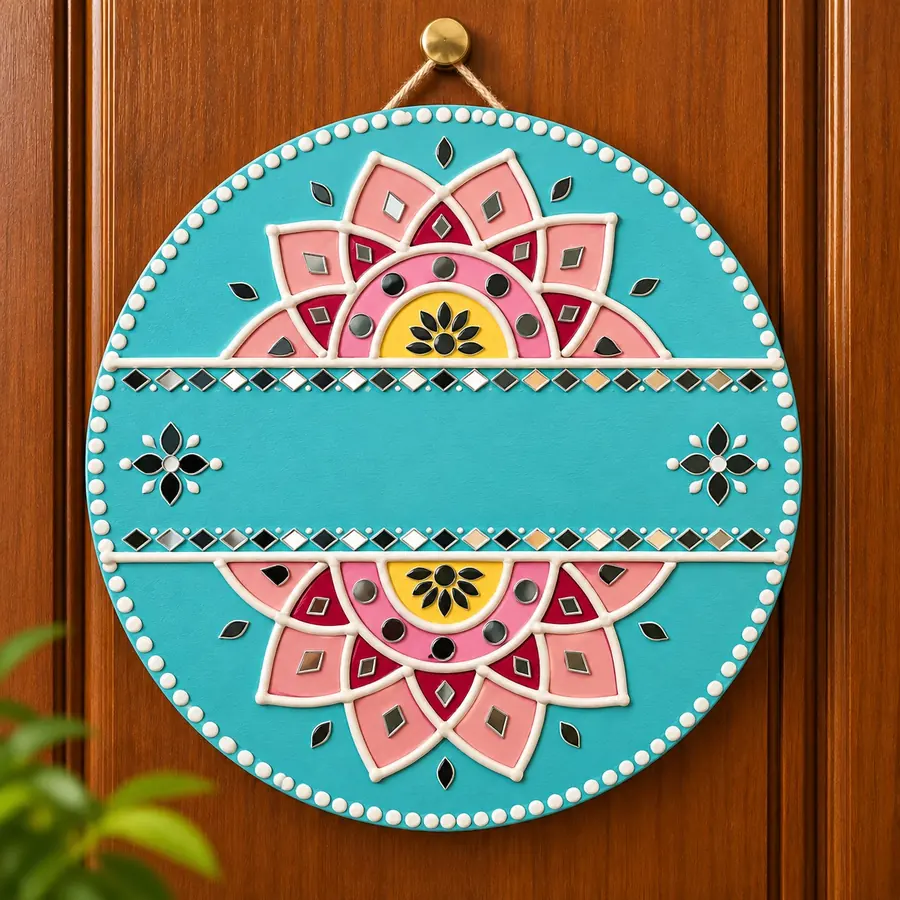
That shift is why a piece like the ones I make exists at all. It is also the point at which the craft stopped being purely functional, because a panel on a board in a lit room is not lighting anything.
Whether that is preservation or dilution is a real argument and I do not think it has one answer. What I can say is that the technique survived because it found a market.
What changed, and what did not
Changed: the surface. Board instead of wall, so it can move. The palette, which is far wider now than white clay on a dark ground. The scale, because a piece has to fit a courier box. And the existence of a named maker.
Unchanged: the clay is still raised by hand, line by line. The mirrors are still set individually while the material is workable. Each layer still has to dry fully before the next, and that still cannot be hurried.
The drying is the thread that connects a modern panel to a bhunga wall. It is the one part of the process no modernisation has managed to shorten.
Why any of this matters when you are buying
It tells you what you are paying for. The hours are in the raising and the setting, not in the painting, so detailing drives the price more than size does.
It tells you where to hang it. A craft invented to catch lamplight still wants light, and a craft made of earth still cannot live in a damp room.
And it tells you what to be sceptical of. Moulded relief, glued-on mirrors and elaborate symbolic readings are all modern additions, and none of them come from Kutch.
Seeing it where it belongs
Bhuj and the villages around it are the place to see this properly, and several craft villages in the region receive visitors.
The work on an actual bhunga wall is a different thing from anything on a board, including mine. It is bigger, it curves, and it is lit the way it was meant to be.
If you are ever in Gujarat, go. It is the only way to understand why the mirrors are placed the way they are.