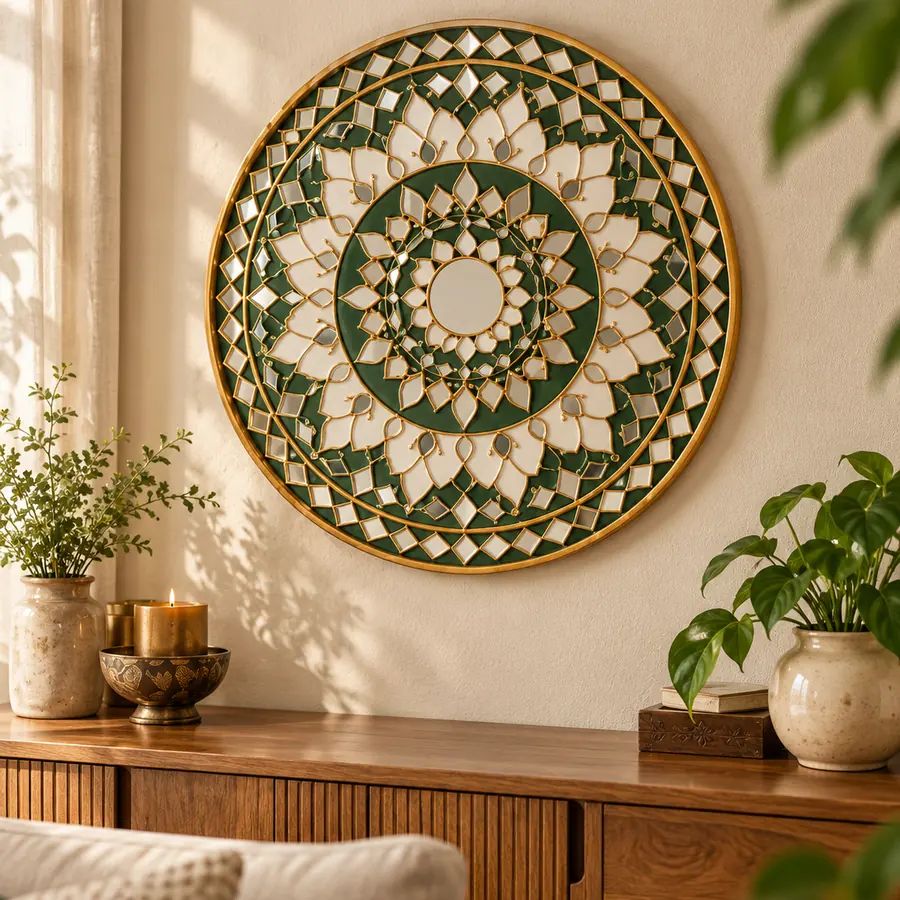
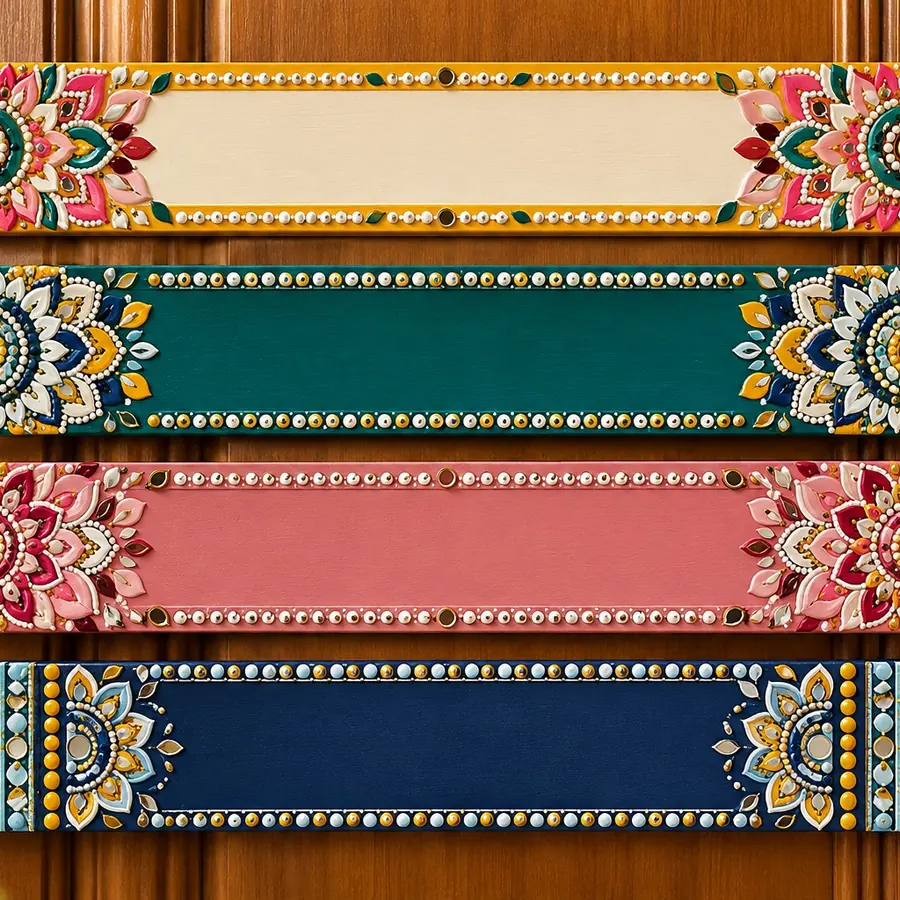
Tall walls
Filling a staircase or a double-height wall
A stairwell is the one wall in a house that is seen from below, from above, and in motion, and almost never straight on from the middle. Most art advice assumes you are standing still in front of a piece at eye level. None of that applies here, which is why stairwells stay empty in houses where every other wall is done.
Made to order in Sector 67, Gurugram · from ₹700 · shipped across India & worldwide
Measure along the rake, not the wall
The useful line on a staircase wall runs parallel to the stair nosings, not parallel to the floor or the ceiling. Everything you hang should follow it.
Stretch a length of string from the nosing of the bottom step to the nosing of the top one and hold it against the wall. That is your baseline.
A group hung level with the floor on a staircase wall looks wrong immediately and most people cannot say why. The rake is why.
Viewing distance changes everything
On a stairwell you see the lowest piece from close and the highest from far, often across a void.
So fine detail at the top is wasted and a piece intended to be read up close should go low. This is the opposite of a gallery wall, where everything sits at one distance.
The highest piece should work as a shape. If it only makes sense when you can see its detail, it is in the wrong place.
One tall piece or a climbing group
A single tall piece is calmer and far easier to hang, and in a narrow stairwell it is usually the better answer.
A climbing group suits a longer run and a double-height void, and it gives you something at each landing rather than one thing seen once.
If you group, keep the gaps consistent measured along the rake, and keep the pieces the same size. Varying both at once on a diagonal reads as accident rather than arrangement.
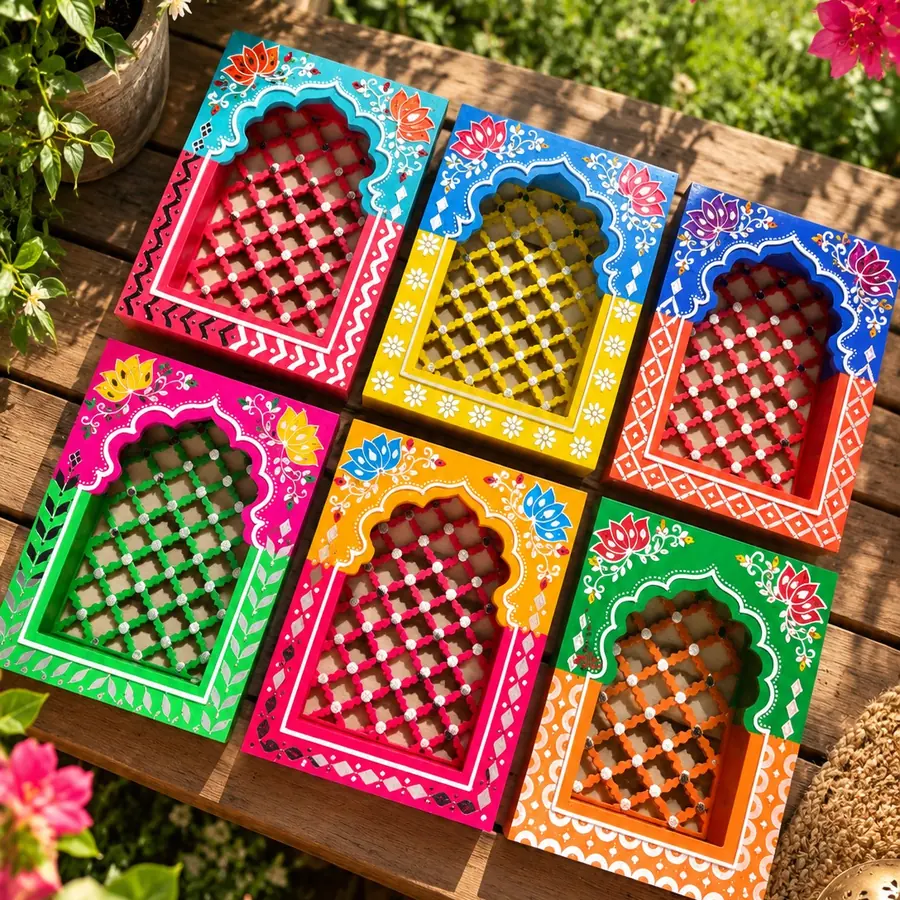
Why Jharokha frames suit this better than anything else I make
A jharokha is a window, so a vertical proportion is native to it rather than imposed.
They were made to be seen in a group on a haveli facade, which is structurally the same problem as a stairwell: several similar elements climbing a tall surface.
And because the jaali screen is pierced, the wall colour shows through, which stops a run of them reading as heavy on what is usually a confined space.
A set of three to six works where one large panel would dominate.
Double-height living rooms
Different problem again. Here the wall is tall and you are usually seated, so the whole upper half is seen at a steep angle or not at all.
Resist filling the top. The useful zone runs from around a metre off the floor to roughly three metres, and above that you are decorating for nobody.
One large piece low on a double-height wall looks more considered than a tall column of small ones reaching for the ceiling.
Light, which is usually bad
Stairwells are often lit by a single fitting, frequently overhead and frequently harsh.
Overhead light directly above relief work flattens it, because the shadow falls straight down behind the piece rather than across it.
If you can angle a light across the wall, mirror work comes alive. If you cannot, painted work with strong colour is the safer choice and I will say so if you tell me the lighting.
Hanging safely on a stairwell
This is the hardest wall in a house to work on and the easiest to fall off. If the drop is significant, pay somebody.
Two fixings per piece, spread across the width, into masonry or a stud. A single hook on a stairwell lets a piece rotate, and nobody notices until it is visibly crooked.
Avoid hanging anything within arm's reach of the handrail at shoulder height. People carry things up stairs and will catch it eventually.
Keep clay relief away from the top of a stairwell in a house with a kitchen below an open plan. Heat and cooking vapour rise, and that is where they collect.
What tends to go wrong
Hanging level instead of on the rake.
Putting the detailed piece at the top where nobody can see it.
Choosing pieces too small for the height, which happens because people size them by the width of the wall rather than its area.
Forgetting the piece will be seen from above as well, so the top edge matters more here than anywhere else in the house.
Commissioning for a stairwell
Send me a photograph taken from the bottom of the stairs looking up, and a second from the landing looking down. Those two pictures tell me more than any measurement.
Give me the rise and run if you can, or just the number of steps and the ceiling height.
Say what light there is and where it comes from. On a stairwell that decides whether mirror work is worth it at all.