Telling them apart
Pichwai, Tanjore and Kalamkari are three different things
These three get grouped together as traditional Indian painting and sold alongside each other, which hides how little they have in common. Different regions, different materials, different reasons for existing. I make Pichwai and I do not make the other two, so what follows is a comparison rather than a sales pitch for one of them.
Made to order in Sector 67, Gurugram · from ₹700 · shipped across India & worldwide
Telling them apart in ten seconds
Gold that stands proud of the surface, with stones or glass set into it, on a stiff board: Tanjore.
Soft earthy colour on cloth, fine pen-drawn outlines, no gold: Kalamkari.
Cloth, devotional, built around a central figure with dense symmetrical surroundings: Pichwai.
If you remember one thing, make it the gold. Raised gold foil is Tanjore and almost nothing else.
Pichwai
From Nathdwara in Rajasthan. The name is literal: pichh means behind, wai means hanging. These were cloth panels hung behind the idol of Shrinathji in the temple.
The subject is fixed by that purpose. Shrinathji, and around him lotuses, cows, peacocks and decorated elephants, with the composition built symmetrically around the central figure.
Traditionally painted on cloth with natural colours. The panels changed with the festival calendar, so a Pichwai is tied to a season as well as a deity.
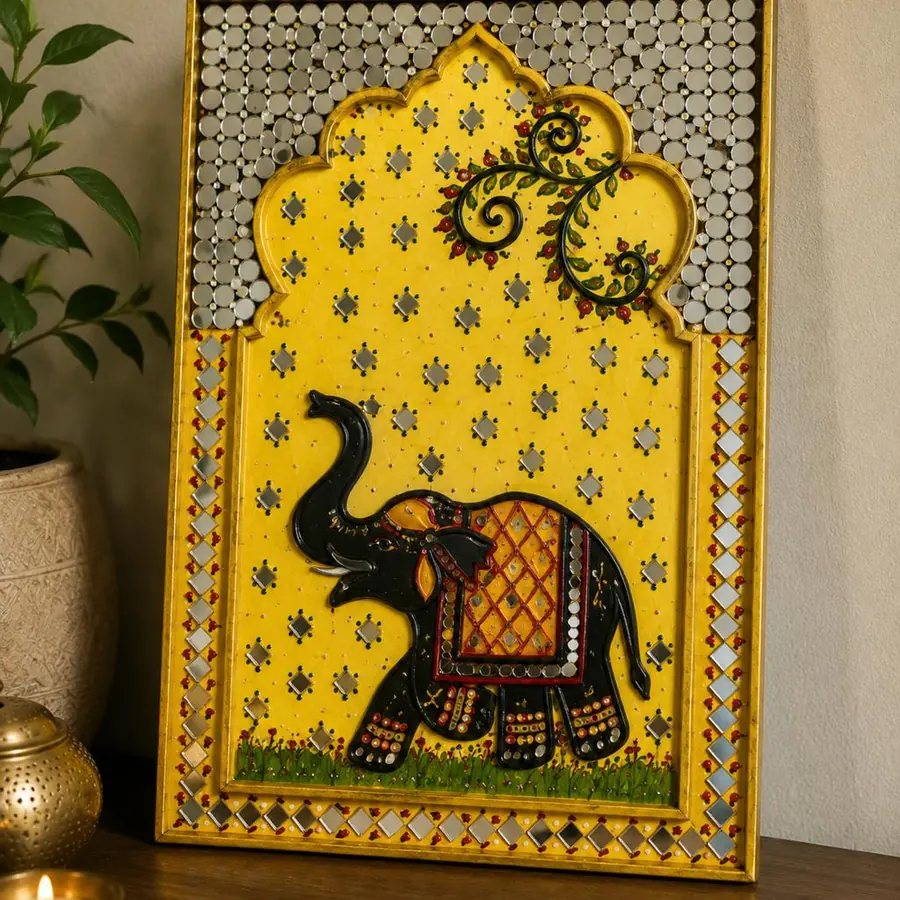
What I make keeps the subjects and the symmetry but works them in relief with mirror detailing rather than flat on cloth, which is an adaptation and I say so rather than calling it traditional.
Tanjore
From Thanjavur in Tamil Nadu, and it is the most immediately recognisable of the three because of the gold.
The technique is what makes it. A raised gesso paste is built up on the surface, and gold foil is laid over that relief, so the gold physically stands off the panel. Glass beads and stones are often inlaid into it.
Usually on cloth stretched or pasted over a wooden board, which is why Tanjore work is rigid rather than flexible. Modern pieces commonly use plywood.
Subjects are overwhelmingly deities, with Krishna the most common.
If someone offers you a flexible Tanjore on loose cloth with no raised gold, something is wrong with the description.
Kalamkari
From Andhra Pradesh, and the name comes from kalam, meaning pen. The work is drawn onto cotton with a pen rather than painted with a brush in the usual sense.
Natural dyes throughout, from plants and minerals, which is why the palette runs to indigo, rust, ochre and black rather than bright saturated colour.
There are two distinct traditions and they are often sold as one thing. Srikalahasti is hand-drawn and temple-linked. Machilipatnam is block-printed. A hand-drawn piece and a block-printed piece are not the same object or the same price.
The cloth is prepared with mordants before any drawing happens, and the colour is built through staged dyeing rather than applied in one pass.
What they have in common, which is less than you think
All three are Indian, all three are traditional, and all three were made for a purpose rather than for a wall in somebody's flat.
That is about the extent of it. The materials differ, the regions are a thousand kilometres apart, and the techniques share no common method.
Grouping them as traditional Indian painting is a retail convenience, not a family relationship.
Where the confusion actually comes from
Shops sell them side by side under one heading, and the photographs flatten the differences that matter. Raised gold looks like painted gold in a thumbnail.
Subjects overlap. Krishna appears in Tanjore and in Pichwai, so two pieces of the same deity in different traditions sit next to each other and look related.
And there is genuine historical cross-influence in South India between painting traditions, which makes the edges blurrier than a clean comparison suggests.
Which suits which wall
Tanjore is formal and it reflects. It wants a wall with controlled light, because strong direct light on gold foil is glare rather than glow. It suits a pooja room or a formal entrance.
Kalamkari is soft and textile. It suits a relaxed room and sits well with wood and plants. It is the most forgiving of the three in a casual interior.
Pichwai is devotional and symmetrical, which makes it the natural pooja room choice, though it works on a formal living room wall too.
The practical difference: Tanjore is rigid and heavy, Kalamkari is cloth and light, Pichwai depends on how it has been mounted.
Caring for each
Tanjore: keep it out of damp, and never clean the gold with anything wet. The gesso underneath is not waterproof.
Kalamkari: it is cloth and natural dye, so direct sunlight will fade it faster than you expect. Keep it off a sunny wall.
Pichwai on cloth: the same sunlight warning applies. Worked in relief, as I make it, the clay rules apply instead, which means no damp and no damp cloth.
None of the three belongs in a bathroom.
What I make, and what I do not
I make Pichwai, worked in relief with mirror detailing rather than painted flat on cloth.
I do not make Tanjore or Kalamkari, and I am not going to pretend otherwise so that a page ranks. If one of those is what you want, buy it from somebody who makes it properly.
If you are deciding between traditions for a particular wall, send me a photograph and I will tell you honestly which of the three I would put there, including when the answer is not mine.