Madhubani styles
The styles within Madhubani
Madhubani is usually described as one thing, and then you see two pieces side by side that share almost no visual language. That is because Madhubani contains several named styles. It is a tradition from the Mithila region of Bihar, and the differences between them came partly from caste and community rather than from individual preference. Knowing which is which changes what you are looking at.
Made to order in Sector 67, Gurugram · from ₹700 · shipped across India & worldwide
Why there are styles at all
Madhubani was painted on the walls and floors of homes in the Mithila region for weddings and festivals, by women, and it stayed domestic for a very long time.
Within that, different communities developed different approaches, and those became recognised styles with names.
The commercial shift came in the twentieth century when the work moved onto paper and began to be sold. That is when the styles became labels you could ask for by name, rather than simply how a particular family painted.
Bharni
Bharni means filling, and that is literally the method. Bold outlines are drawn and then filled in with solid colour.
Heavy, saturated, and the most immediately recognisable Madhubani to most people. Reds, yellows and deep greens.
Subjects lean devotional: Krishna, Rama, Durga, Shiva.
If you picture Madhubani and see strong flat colour inside thick black outlines, you are picturing Bharni.
Katchni
The opposite approach. Katchni uses fine hatched line work to build form, with very little filled colour, often monochrome or close to it.
The detail is extraordinary when it is done well, and it rewards being looked at from close range in a way Bharni does not need.
Because it depends on line density rather than colour, it reads quieter on a wall and suits a room where you do not want another strong colour.
Godna
Godna means tattoo, and the style takes its vocabulary from tattoo patterns.
Built from repeated small motifs arranged in rows and concentric bands, often in a restricted palette.
It is the most pattern-driven of the styles and the least figurative, which makes it the easiest to live with if you want texture rather than a subject on the wall.
Tantrik
Religious and symbolic, drawing on tantric iconography and ritual diagrams.
More specialised, and less commonly made for general sale than Bharni or Katchni.
Worth being careful here. Tantric imagery carries specific meaning and buying it as decoration without knowing what it depicts is how people end up with something they would not have chosen.
Kohbar
Not a style in the same sense as the others, but the most important Madhubani composition there is, so it belongs in any list.
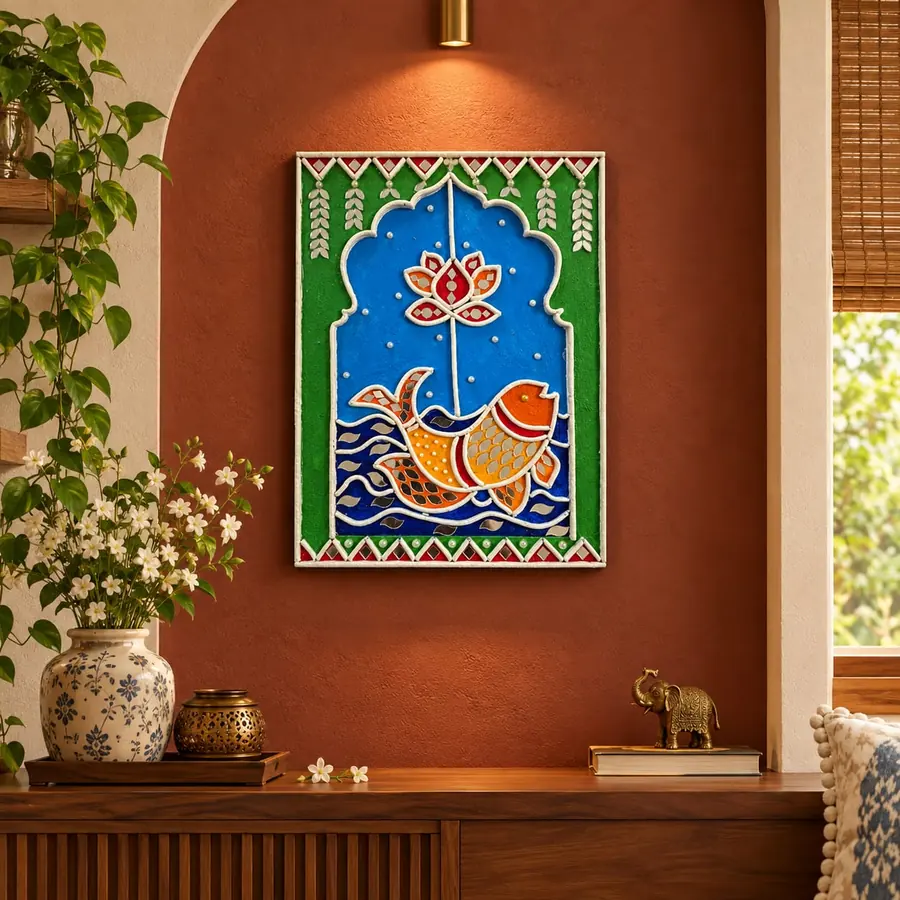
The kohbar is painted for a marriage, in the kohbar ghar, the room where the newly married couple spends their first nights. Lotuses, bamboo and fish, read as fertility and union.
This is the piece that explains why Madhubani exists as a practice. It was not made to be looked at by strangers.
If you are buying a wedding gift and want the motif to carry meaning rather than decoration, this is the vocabulary to ask about.
How to tell them apart quickly
Solid filled colour inside bold outlines: Bharni.
Fine hatching, little or no fill: Katchni.
Repeating small motifs in bands, pattern over figure: Godna.
Ritual diagrams and symbolic figures: Tantrik.
Lotus, bamboo and fish arranged for a marriage: a kohbar, in whichever style it has been painted.
The motifs, which run across all of them
Fish for fertility and good fortune. Lotus for purity. Peacocks, elephants, the sun and moon, and trees of life.
Space is traditionally filled completely. Empty background is not part of the convention, which is why a Madhubani piece looks dense even when the subject is simple.
The symbolism is genuinely specific here, unlike Lippan where the meaning sits in symmetry rather than in individual elements. If you want a piece to say something particular, Madhubani is the tradition that can.
What I make, and how it differs
I work Madhubani subjects in raised relief with mirror detailing rather than painting them flat on paper or cloth.
That keeps the drawing and the symbolism and changes the surface, and the honest description is that it is an adaptation rather than a traditional Madhubani painting.
Closest in spirit to Bharni, because relief and mirrors want bold form rather than fine hatching. Katchni does not translate into clay; the line work is too fine to raise.
If you want a traditional flat Madhubani on paper in the Katchni style, I am not the right maker and I will say so.
Choosing a style for a room
Bharni if the room is plain and can take strong colour, or if the piece is a gift where the subject matters.
Katchni if the room already has enough colour and you want detail instead.
Godna if you want pattern and texture without a subject competing for attention.
Kohbar if it is a wedding and you want the motif chosen deliberately.