Lippan art
Lippan art, handmade to order in Gurugram
Lippan is the mud-and-mirror relief craft of Kutch, in Gujarat. Raised clay lines are built up by hand and set with small mirrors that catch whatever light the room has. I make Lippan pieces to order from my studio in Sector 67, Gurugram — in the size your wall needs and the colours your room already uses.
Made to order in Sector 67, Gurugram · shipped across India & worldwide
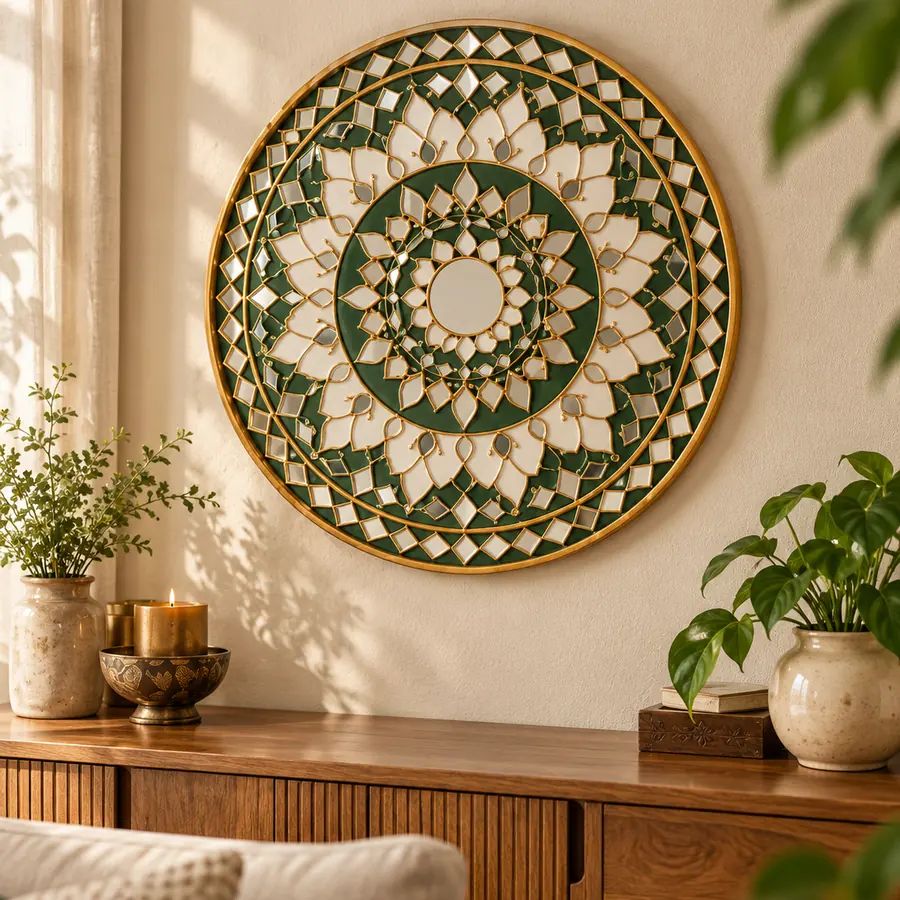
What Lippan art actually is
Lippan kaam — literally 'mud work' — comes from the Kutch region of Gujarat, where it was traditionally applied to the interior walls of bhungas, the round mud houses of the area. A paste of clay and camel dung was pressed into raised patterns on the wall, and pieces of mirror were set into the design.
The mirrors were not decoration alone. In a house lit by a single oil lamp after dark, dozens of small mirrors spread that light around the room. The craft is practical before it is beautiful, which is true of most village art.
What I make is the same craft moved onto boards, so it can hang in a flat in Gurugram rather than be built into a wall. The technique is unchanged: the pattern is drawn, the clay relief is raised by hand line by line, the mirrors are set while it is still workable, and each layer dries before the next one goes on.
Why it takes the time it takes
Every raised line is laid by hand. There is no mould and no press, so two pieces from the same drawing are never quite identical — the thickness of a petal, the angle a mirror catches the light.
Drying is the part people do not expect. Clay relief has to dry slowly and evenly between layers or it cracks, and that pace depends on the size of the piece, how deep the relief is and the weather that week. It is the main reason I quote a timeline per piece instead of publishing one number that would be wrong half the time.
Made for your wall, not from a catalogue
Most of what I make starts with someone sending a photo of an empty wall. From that I work out what size will sit right, which shapes suit the space, and which colours pick up what is already in the room.
You see a design before anything is made. Nothing gets built until you have approved the drawing, the size and the price.
Round mandala forms are the most requested, but Lippan works just as well as a square panel, a pair of long vertical pieces either side of a doorway, or a name plate for an entrance.
Where a Lippan piece works best
Living room walls above a sofa or console, where the mirrors have light to work with. Entrance walls and foyers, which is where name plates usually go. Pooja rooms, where the traditional association is strongest.
Keep it indoors and away from steady moisture. A balcony wall that gets rain, or a bathroom, will shorten the life of a clay piece considerably.